
A wave can travel without carrying its medium along with it. In a stadium, the crowd’s rising arms sweep around the stands while each person stays in place. A similar trick, played out among electrons, could one day help computers process information without the electric currents that generate waste heat.
The catch is that these magnetic ripples—called magnons—do not last forever. They can hand their energy to vibrating atoms in a crystal. Researchers studying copper oxide have now found that this handoff takes surprisingly long, even though magnetism and atomic motion in the material are strongly connected. The delay may offer a useful window for controlling the ripples.
The traffic problem inside a crystal
In ordinary computer chips, information is carried by moving electrical charge. As components get smaller and computing demands grow, the resulting power use and heat become harder to ignore. Spintronics explores another possibility: use the spin of electrons—their quantum-mechanical magnetic orientation—to encode and move information, potentially without making the electrons themselves flow from place to place.
In a magnetic material, neighboring spins can move together in coordinated patterns. A magnon is a ripple in that pattern, rather than a tiny particle travelling through the crystal like a ball. It is a quasiparticle: a way of describing a collective motion that behaves, in important respects, as if it carries its own energy and momentum.
But a crystal is not just a grid of magnetic compass needles. Its atoms vibrate, too, and those vibrations are described as phonons. The central question is how quickly magnons pass their energy to phonons—and whether that exchange can be steered. For a future logic device, a spin wave that fades almost immediately would be difficult to use; one that persists could leave more time to manipulate it.
Following an energy handoff across a billionfold span
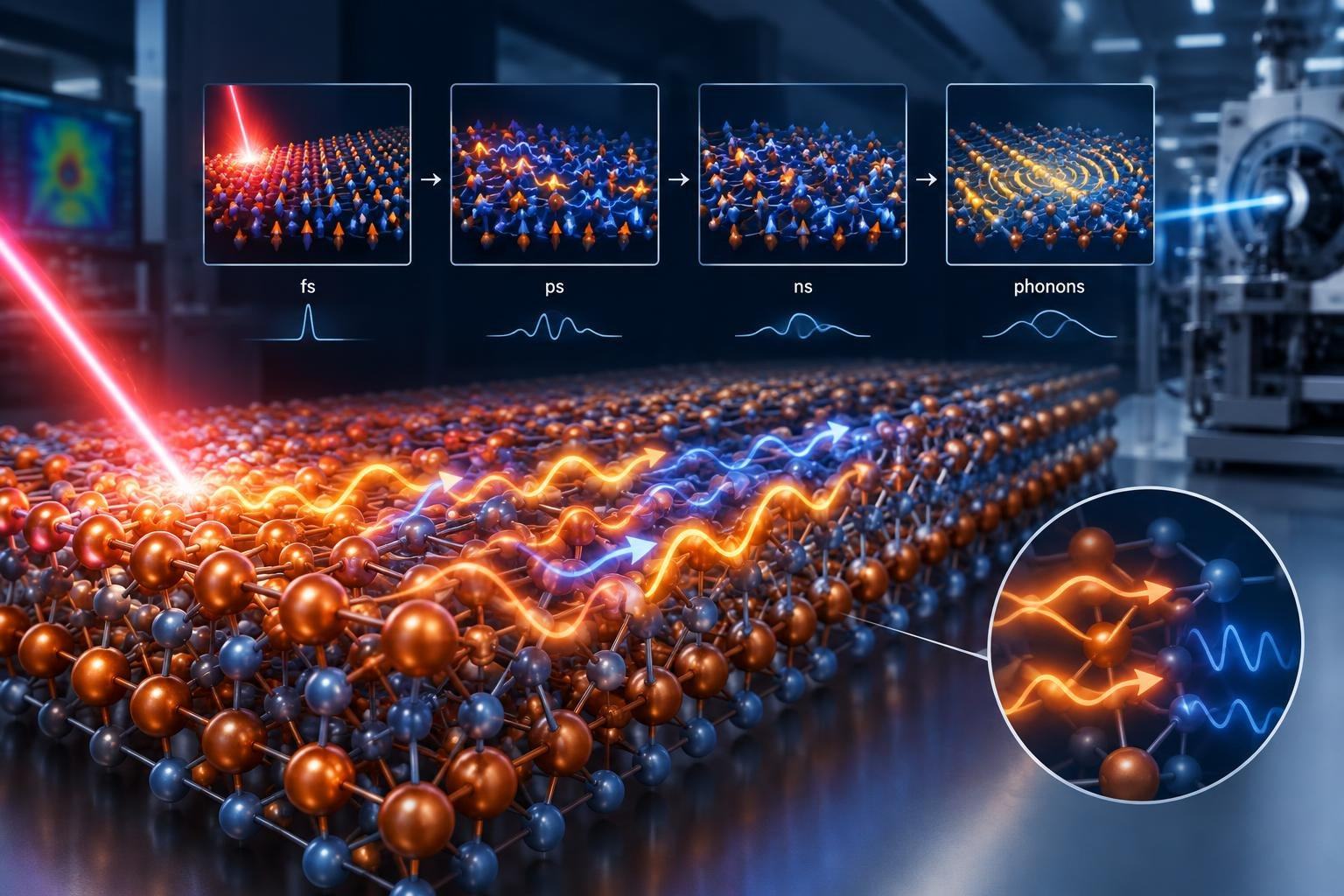
To watch the process, the team led by Hiroki Ueda at the Paul Scherrer Institute first struck a copper oxide sample with a short, intense optical laser pulse. The pulse excited electrons, setting off a rapid reorganization of spins that generated magnons in femtoseconds—quadrillionths of a second.
Those magnons then scattered among themselves. Over picoseconds, their initially organized motion became an incoherent jumble, compared by the researchers to rough seas. Only later, on nanosecond timescales, did they transfer energy to the crystal lattice and produce phonons. These intervals are all extraordinarily brief by everyday standards, but they span several orders of magnitude in the microscopic world.
The surprising part was not simply that the magnons lasted a long time. Copper oxide has strong interactions between magnetism and the lattice, which might suggest an efficient route for energy to escape. Instead, the team found that the relationship between energy and momentum for magnons differs from that for phonons. That mismatch can make the handoff less efficient: strong interaction does not necessarily mean rapid energy transfer.
X-rays turn fleeting motion into a sequence
Capturing the full story required more than one kind of measurement. The researchers combined X-ray methods, including a technique called time-resolved resonant diffuse scattering, at the SwissFEL free-electron laser in Switzerland. Other measurements were made at the ESRF synchrotron in France.
The approach works like a microscopic flipbook. After the optical pulse starts the action, an X-ray pulse probes the sample at a chosen delay. By changing that delay and repeating the measurement, researchers can assemble snapshots of how the material evolves. Quantum kinetic simulations helped model the energy flow, and the results largely agreed with the measurements.
The study, published in Nature Communications, offers a more connected view of how electronic, magnetic and lattice excitations interact than measurements of any one piece alone. It does not demonstrate a working spintronic computer. But it points to a design principle worth exploring: tune a material’s energy-and-momentum relationships to control how long its spin waves survive.
That possibility turns the apparent contradiction into a useful clue. In a crystal, magnetism can be strongly coupled to its surroundings and still hold on to energy—not because nothing can take it, but because the available handoff is awkward. For future electronics, the important question may be not how to stop a wave from fading, but how to make the crystal reluctant to let it go.