
Imagine watching a week-long event take six weeks to unfold. That is the strange advantage astronomers have when they study a supernova from the early universe: cosmic expansion stretches not only the light reaching us, but also the apparent timing of the event.
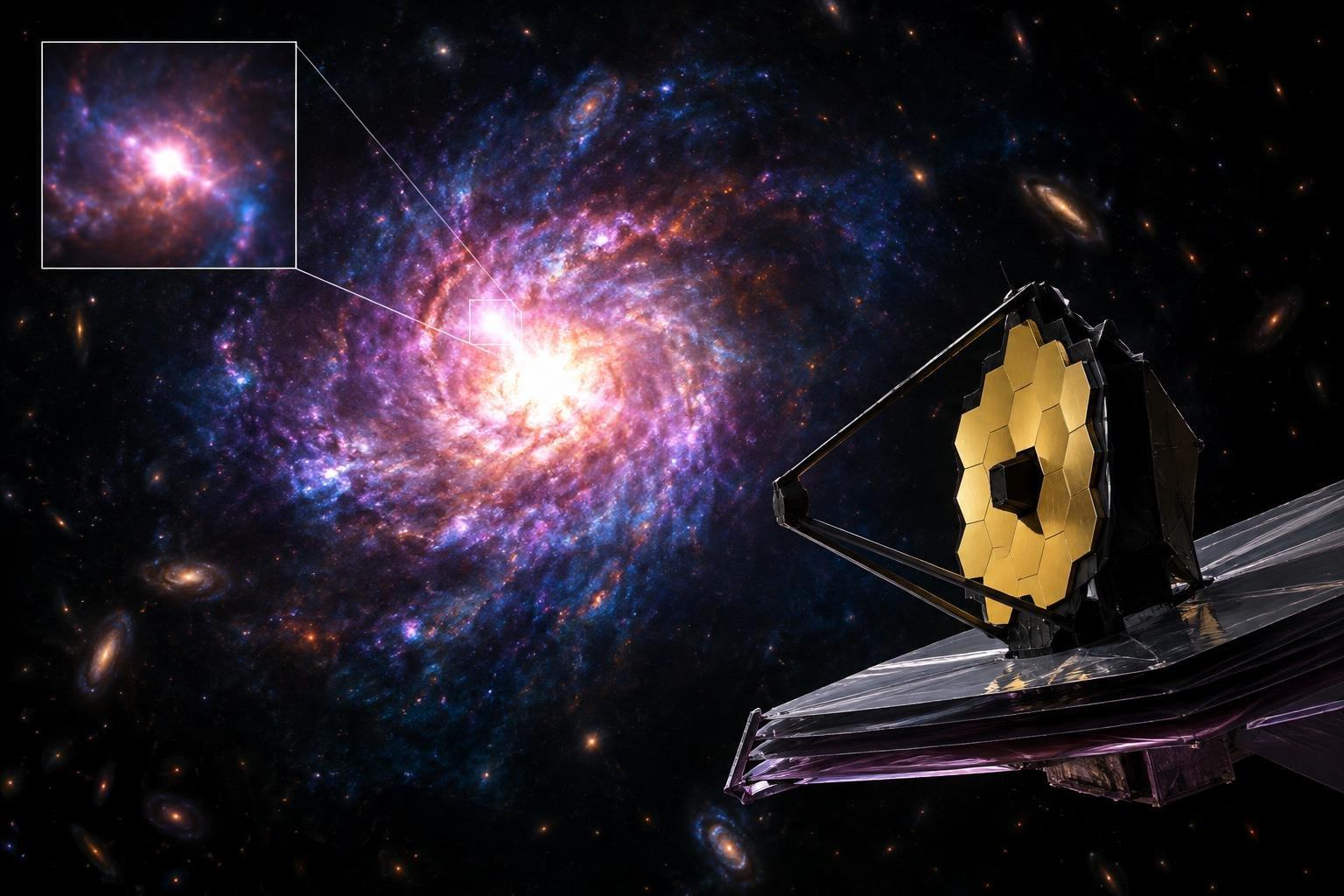
The James Webb Space Telescope may have caught just such an explosion, named AT 2026abck, in a galaxy seen as it was about 1.15 billion years after the Big Bang. The light has travelled for roughly 12.5 billion years to reach us. In a study posted as a preprint, researchers say they may be seeing the supernova only four to 10 days after it erupted—by the star’s own clock.
A cosmic event in slow motion
The telescope observed the galaxy, ID101411, on May 28, 2026, without seeing the supernova. When it looked again on August 7, the new point of light had appeared. Seventy-one days passed for observers on Earth, while the team estimates that only about 12 days passed at the explosion.
This is cosmological time dilation, not a change in how time works near the star. As the universe expands, light travelling across it is stretched. For this distant event, changes that took about a week in the supernova’s frame appear to take roughly six weeks to us. Webb is not watching the explosion live; it is receiving an unusually drawn-out recording carried across the cosmos.
That timing could help astronomers study an explosion at an exceptionally early stage. Supernovas change rapidly after they ignite, as hot, ejected material expands and cools. Catching one near the beginning offers clues that may be lost by the time a more nearby telescope first spots it.
A flash nearly as bright as a galaxy
AT 2026abck is extraordinarily luminous. At its peak, the researchers estimate, it shines with the brightness of about eight billion Suns—approaching the light of the entire Milky Way. Its temperature is estimated at more than 30,000 degrees Fahrenheit, and its expanding shell of stellar debris spans a radius of about 46 times the distance between Earth and the Sun.
The host galaxy helps place the blast in context. ID101411 contains about 6.3 billion solar masses and is forming stars at more than ten times the Milky Way’s rate, according to the study’s authors. In the young universe, galaxies were rapidly building their first generations of stars. They also contained fewer “metals”—astronomers’ name for elements heavier than hydrogen and helium, forged inside stars and scattered by stellar deaths.
What kind of star made this light show is still uncertain. The team suggests it could be a superluminous supernova, a rare class that releases far more energy than an ordinary stellar explosion. But that remains a preliminary interpretation, not a settled identification. Further observations of whether the blast continues to heat up or begins cooling could help reveal what powered it.
Finding a flash without a cosmic magnifying glass
There is another reason this sighting stands out: the team did not rely on gravitational lensing. A massive object can bend and magnify light from something behind it, much like a lens. Such natural magnification has helped astronomers find other very distant supernovas; this one appears to have been detected without that boost.
The discovery came through NEXUS, a Webb program that revisits selected patches of sky in search of ancient transients. Repeated observations are essential: the telescope must look at the right tiny region, and an explosion must happen between visits. The May-to-August sequence gave astronomers the rare before-and-after clues needed to estimate when the star erupted.
The research is still a preprint and has not yet been peer-reviewed, so the explosion’s nature may change as evidence accumulates. But even that uncertainty is part of the appeal. Webb has found a brief stellar death so distant that expansion has turned its first days into a slowly arriving signal. The universe has not paused the explosion; it has stretched the message of its beginning across time.