
A refrigerator performs a small, everyday magic trick: it makes one place colder by making another place warmer. The trick itself is old. For roughly 170 years, heat pumps and refrigerators have relied on circulating fluids to carry heat from where it is not wanted to where it can escape. Now a startup called Pascal is trying to improve that familiar exchange—not by inventing a brand-new kind of machine, but by changing what happens inside it.
The idea emerged from a scientific puzzle. Adam Slavney and Jinyoung Seo were testing materials for more efficient cooling when they found that changing the gas used in their experiments changed the results, too. The difference took further experiments to explain. That unexpected clue now underpins Pascal, where Slavney is CEO and Seo is CTO.
Heat moves; the machine does the work
To understand the twist, it helps to start with an ordinary refrigerator. Its cooling system circulates a refrigerant that absorbs heat inside the fridge and releases it outside. A compressor helps drive the cycle. The fridge is not removing “cold” so much as pumping heat in the direction it would not naturally go—a bit like carrying water uphill.
That basic approach has proved remarkably useful, but the fluids have a troubled history. Older refrigerants such as Freon damaged the ozone layer; some newer ones, including R-134a, are powerful greenhouse gases. Replacements must do more than avoid environmental harm: they also have to move heat effectively and work in practical appliances. Finding a better refrigerant has often meant trading one problem for another.
Researchers have therefore explored solid-state cooling materials. Unlike a circulating fluid, a solid cannot simply leak out of a pipe and escape into the atmosphere. Some of these materials heat up when squeezed and cool when pressure is released, creating a way to move heat without relying on conventional refrigerants.
A sponge gives the gas somewhere to go
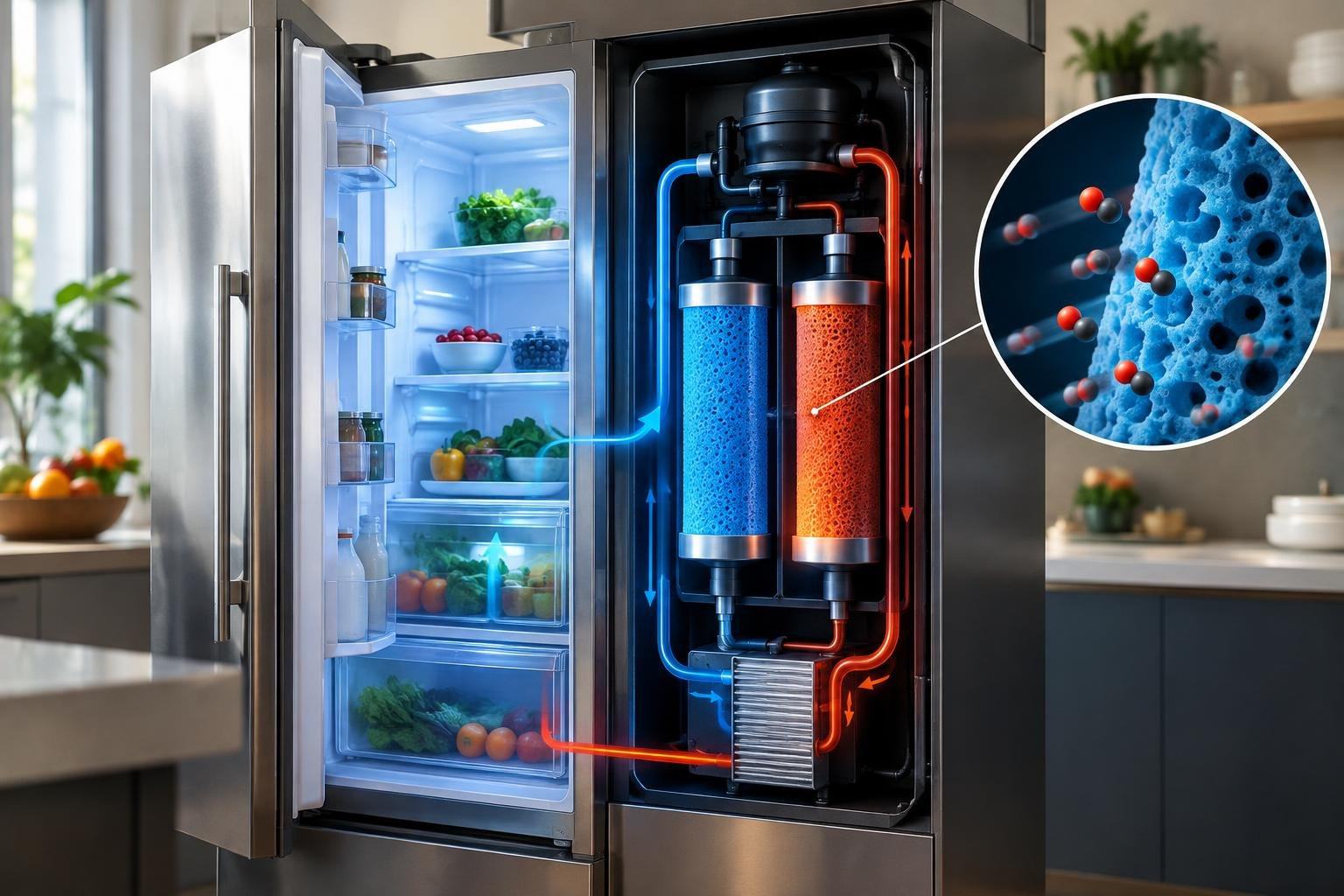
Pascal’s approach combines a gas with a porous, sponge-like material housed in a cartridge. The company says its material is proprietary. Rather than compressing a solid block, the system compresses carbon dioxide and pushes it into the material’s tiny pores. There, gas molecules collide with the pore walls, transferring energy to the solid and warming it. A heat exchanger carries some of that heat away.
Reverse the process and the material can take in heat and pass energy back to the carbon dioxide. In a refrigerator, Pascal says, two cartridges work in tandem: one absorbs heat from inside the appliance while the other releases heat to the outside air. When the cartridges become too hot or too cold to keep doing their jobs, the flow switches direction.
That design is not a claim that the refrigerator contains no gas, or that carbon dioxide has no climate impact. Its potential distinction is that the solid material stays put, while the system uses a familiar gas in a controlled cycle. Pascal says the arrangement moves heat more effectively than other solid-state refrigerants, without requiring the high pressures those alternatives may need.
From a curious result to a working fridge
The company’s next challenge is proving that laboratory promise can survive everyday use. Slavney says the material has been cycled 300,000 times—roughly equivalent, he estimates, to a year of operation. Pascal has signed a pilot contract with a multinational beverage company and plans to deliver its first prototype in early 2027. It hopes to make a more polished batch of refrigerators in 2028.
Pascal also says its technology could make refrigerators and heat pumps around 20% more efficient than existing models. That is a company estimate, not yet a result demonstrated in commercial appliances. The startup has raised $8.5 million in a follow-on to its seed round, with the funding arriving after it secured the pilot customer.
The appeal is not just a clever new material. If a cooling system can use conventional components while moving heat more efficiently—and avoid some of the drawbacks of refrigerant swaps—it could offer manufacturers a less disruptive route to better appliances. But prototypes and a customer pilot are early steps; cost, reliability and real-world performance still have to be established.
For all the sophistication packed into a modern refrigerator, its central job remains wonderfully simple: take heat from here and put it there. Pascal’s wager is that a gas slipping into a solid’s microscopic pores can make that century-old trick work better. The fridge may still feel cold—but the interesting action is happening in the heat it quietly sends away.