
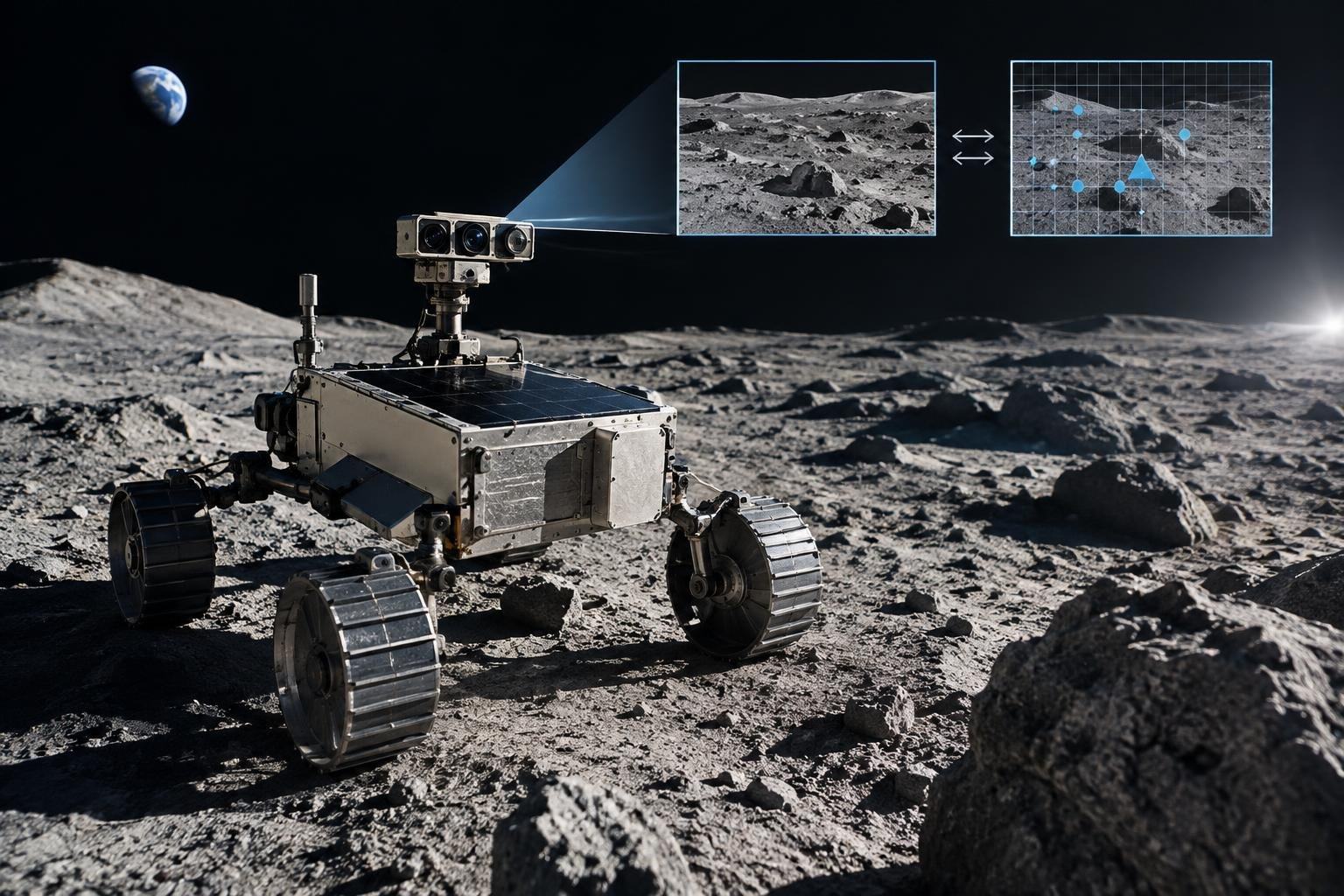
On Earth, a phone can usually settle the question “Where am I?” with a quick GPS fix. At the Moon’s south pole, a rover will have no such shortcut. Instead, it may have to compare the landscape in front of its cameras with a map stored in its memory—and let software work out where the two match.
That navigation challenge is one of the most intriguing jobs planned for FLIP, an uncrewed rover being developed by California company Astrolab. Later this year, FLIP is due to travel to the Moon aboard Astrobotic’s Griffin-1 lander, carrying Hewlett Packard Enterprise’s Spaceborne Computer-4. If the mission reaches the lunar surface as planned, it will be the first time high-performance computing and artificial intelligence are tested there.
A map is only useful if the rover knows where to look
The computer will run a localization experiment based on software developed at NASA’s Jet Propulsion Laboratory and previously used on Mars. The basic idea is like recognizing a familiar room from its arrangement of windows and furniture: the system compares visible features in the terrain with features on a stored map, then estimates the rover’s position.
That matters because a map alone cannot tell a vehicle where it is. On a world without GPS, a rover needs some other way to connect its view of nearby rocks, craters and slopes to a larger map. Matching those landmarks could help FLIP keep track of its route and steer clear of hazards such as dangerous craters.
The system is a practical example of what AI can mean in space. Here, it is not a machine imagining a conversation or making decisions without limits. It is software analyzing visual information to help a vehicle interpret its surroundings. HPE also plans to demonstrate an AI services container, but the exact applications have not been specified.
Computing in a place that can go dark
FLIP’s computer is designed to be compact, lightweight and fanless, with a 64-bit central processor and a graphics processing unit. Solid-state drives from KIOXIA will provide storage. The module is built with heat-conductive aluminum, connects to the rover’s cooling system and draws power from a system supported by batteries and solar cells.
Those details are not just engineering housekeeping. The lunar environment is a severe test for electronics: the equipment must manage heat, conserve power and keep working through long stretches without sunlight. The mission is designed around a year on the surface, including multiple lunar nights and periods of more than 150 hours in complete darkness.
During such a stretch, the rover cannot count on solar cells to provide energy or warmth. FLIP is also intended to operate semi-autonomously for months, when astronauts are not nearby, and travel hundreds of kilometres. Testing the computer in those conditions will help show whether advanced computing can function beyond Earth—not merely in a lab or on a spacecraft passing overhead.
A small machine with a bigger purpose
Griffin-1 is the first mission for Astrobotic’s Griffin lunar lander, flying for NASA under the Commercial Lunar Payload Services program. Alongside FLIP, the mission is set to carry a small CubeRover, an optical navigation system and a tiny archive of human history. FLIP’s payload is one part of a broader effort to develop the tools that could support future work on and around the Moon.
What astronauts might eventually do with lunar AI remains an open question. For now, the experiment is about proving that a computer can process data and support useful tasks in a place where communications, power and human assistance cannot simply be taken for granted.
That makes the rover’s most revealing test a deceptively basic one: can it look at an unfamiliar patch of lunar ground, recognize what it sees and work out where it stands? On Earth, that answer arrives almost invisibly. On the Moon, getting it right could be the difference between a map on a screen and a machine that can actually find its way.