
A helicopter blade has to do two jobs at once: shove air downward to rise, and keep doing so as the rotor spins through an atmosphere far thinner than Earth’s. On Mars, that challenge comes with a twist. Spin too fast, and the blade can approach the speed of sound—not the same threshold it faces on Earth—and suffer a sharp loss in performance.
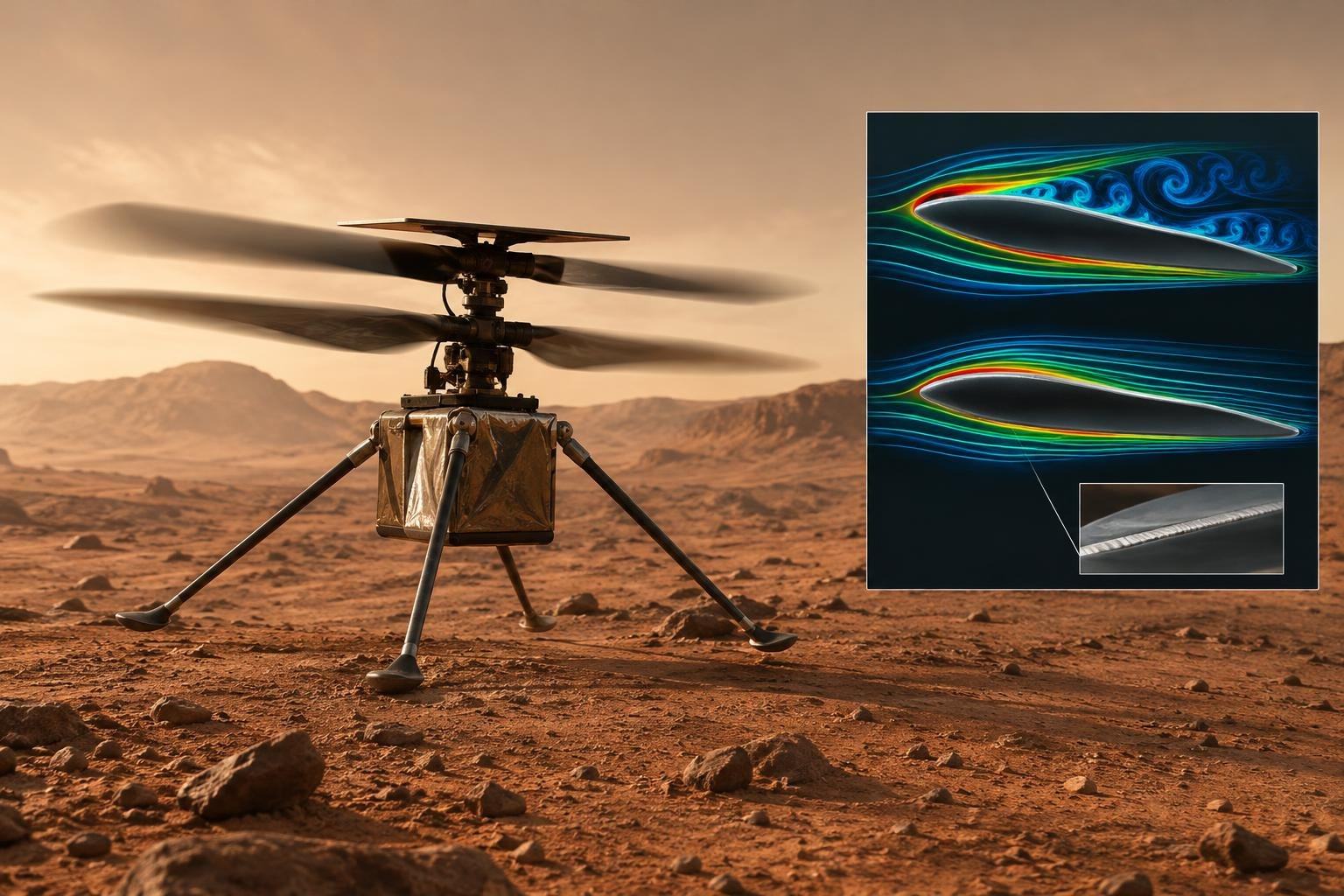
NASA engineers are exploring a new blade shape that could help future Mars helicopters fly farther without simply asking their rotors to work harder. The design, called roamx-0201, is thinner and asymmetrical, and it takes an unusual approach to airflow: instead of trying to keep it perfectly smooth, it deliberately introduces turbulence where the air meets the blade.
Why a faster rotor can hit a wall
NASA’s Ingenuity made history as the first powered aircraft to fly on another planet. Its blades were built for Mars’s rarefied air, and the helicopter covered up to 0.7 kilometers in a single uninterrupted flight. But the physics of flight there leave little room for easy gains: with fewer air molecules to push against, rotors must move quickly to generate lift.
That speed brings its own penalty. As a rotor blade approaches the local speed of sound, drag can rise abruptly and performance can deteriorate—a phenomenon known as drag divergence. The threshold is lower on Mars than on Earth, according to the NASA research, making the blade’s shape and its behavior at high speed especially important.
Researchers at NASA’s Ames Research Center, working with Imperial College London and Nagoya University, used computer simulations and algorithms tuned to Martian conditions to develop the new airfoil, the cross-sectional shape of a blade. Wind-tunnel tests then showed that it performed better and recovered more effectively in risky flight conditions than the team’s earlier design baseline.
When a little turbulence helps
The counterintuitive feature is at the blade’s leading edge—the front edge that first meets the oncoming air. As air flows over a surface, a thin layer next to it, called the boundary layer, can separate from the blade. That separation can undermine lift and contribute to stall, a sudden drop in aerodynamic performance that can make flight unstable.
The roamx-0201 design intentionally disrupts airflow at that leading edge. Rather than treating every disturbance as a problem, the design uses one to alter how air moves over the blade and help produce lift. Under the conditions studied, it also showed better stall behavior than Ingenuity’s blades, suggesting that a future helicopter might remain effective across a wider range of flight angles.
That does not mean turbulence is always useful, or that the blade is ready to fly on Mars. It means engineers have found a way to shape airflow so that a carefully placed disturbance may help rather than hurt. In a place where the atmosphere itself is a limitation, that small change in how air behaves could matter as much as a bigger motor.
From a short hop to a long traverse?
High-fidelity simulations suggest that blades using the new airfoil could let a future Mars helicopter travel as far as 18.7 kilometers in one flight while carrying scientific instruments, compared with Ingenuity’s 0.7 kilometers. That is a projected capability, not a distance already flown: NASA says the technology is not yet ready for Mars, and researchers are still working through differences between computer predictions and real-world tests.
The timing matters for a longer arc of exploration. The Skyfall mission, scheduled to launch in 2028, is planned to send three helicopters to Mars, building on Ingenuity’s demonstration that powered flight is possible there. The new blade research is aimed at missions beyond Skyfall, where longer flights could let helicopters reach more distant terrain and bring instruments along to investigate it.
On Earth, a gust of turbulence can make a flight uncomfortable. On Mars, engineers are asking whether a deliberately shaped disturbance can help an aircraft stay aloft. The answer is not yet a helicopter crossing the planet—but it points to a compelling idea: sometimes, getting farther begins not by overpowering a harsh environment, but by learning how to work with the way it moves.