
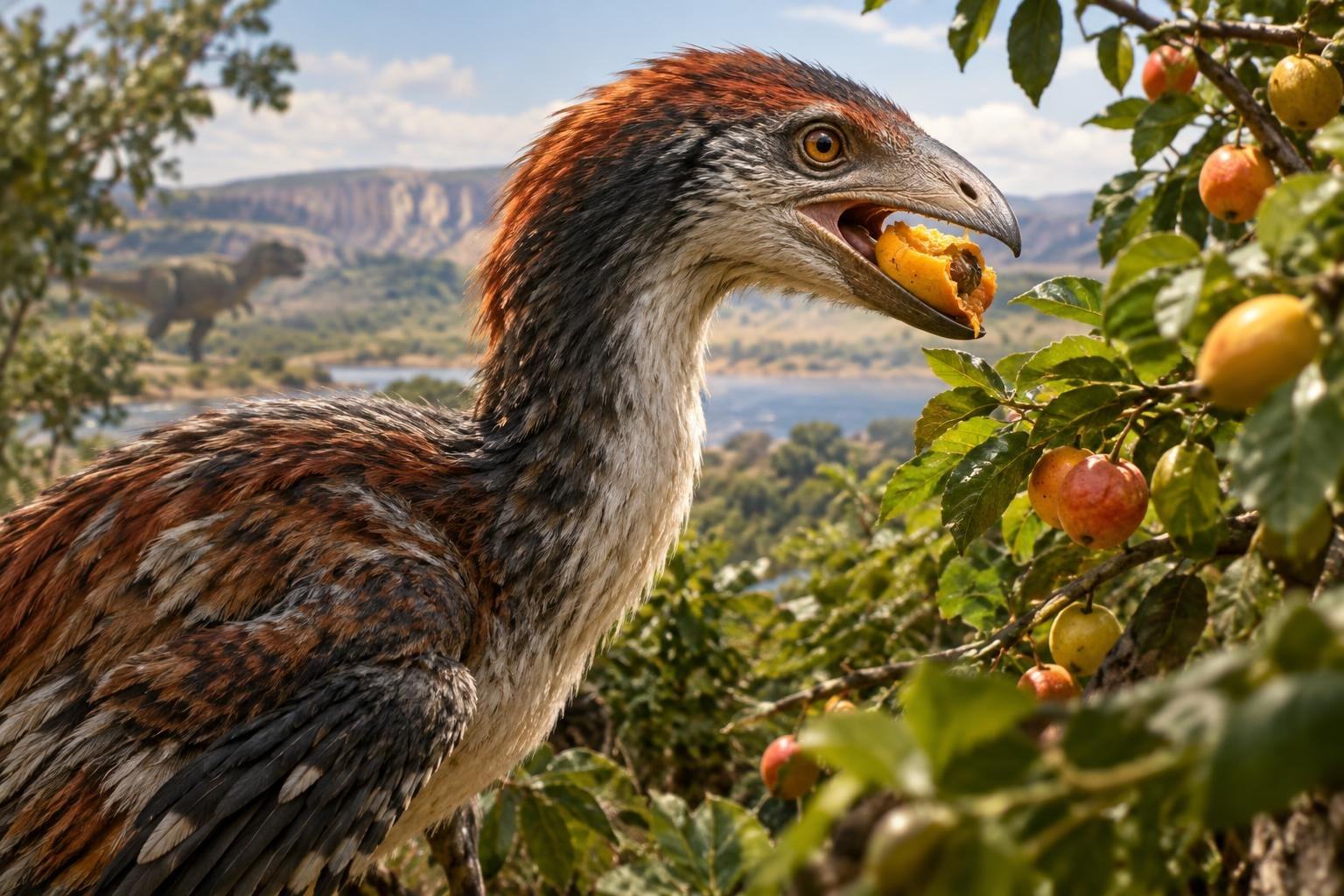
What did a turkey-sized dinosaur do with a mouth built for chewing while giants such as Tyrannosaurus rex hunted nearby? A newly described species, Infernogallus jamesi, appears to have made a living eating fruit—a surprising diet for a dinosaur descended from meat-eating ancestors.
The discovery comes from a nearly complete skull and partial skeleton found in the Hell Creek Formation, a fossil-rich stretch of the American West. The remains belong to a small, toothless, feathered dinosaur called a caenagnathid. Researchers estimate that an adult weighed about 12 kilograms, or 25 pounds: modest company beside T. rex, but equipped with an unusually specialized way of eating.
A skull built for a different kind of bite
The key clue was not simply what the dinosaur’s mouth looked like, but how it could move. Using CT scans to reconstruct the skull, the research team examined the palatal bones—the bones forming the roof of the mouth—and the muscles connected to them. The bones curved down into the mouth, changing the direction in which some chewing muscles worked.
That arrangement, the researchers argue, would have allowed the beak to slide back and forth as the animal chewed. Many dinosaurs, including T. rex, had a more rigid, up-and-down bite. A forward-and-back motion is familiar in mammals: it helps us grind food rather than simply clamp down on it.
Even more striking, the muscle arrangement resembles one found in fruit-eating parrots today, including the vulturine parrot. Such a comparison does not mean the dinosaur and parrot had identical skulls or diets in every detail. It does suggest that, in animals separated by a vast span of evolutionary history, a similar mechanical solution may have helped process soft foods in the mouth.
Why fruit may have changed the dinosaur’s menu
The species’ name, Infernogallus, means “hell chicken,” a nod to the Hell Creek Formation where its fossils were found. Its species name honors James, and the remains are now on display at the Royal Ontario Museum. The new study, led by Stony Brook University paleontologist Greg Funston with collaborators from the museum and the North Dakota Geological Survey, describes the findings in Nature Communications.
The skull’s chewing mechanics led the researchers to infer that Infernogallus could mash stone fruits and separate their fleshy parts from the central seed. That makes it the first known dinosaur identified as a specialist fruit eater. The conclusion is based on anatomy, rather than a preserved meal: the fossils do not show a fruit caught in the dinosaur’s mouth.
The timing offers a bigger evolutionary puzzle. During the Cretaceous Period, flowering plants became increasingly prominent, and the fossil record includes fruits from that era. The researchers see a parallel between the spread of fruit and the evolution of specialized chewing in caenagnathids. The evidence points to a possible relationship, not proof that fruit alone drove the group’s changes.
A dinosaur’s place in a flowering world
Fruit-eating animals can also disperse seeds, carrying them away from the parent plant before depositing them elsewhere. Birds, reptiles and small mammals perform that role today. If dinosaurs such as Infernogallus ate fruit, they may have helped move seeds through Cretaceous ecosystems too—but the discovery raises that possibility; it does not establish how much they contributed.
That distinction is part of what makes the skull so valuable. Complete remains of small dinosaurs are rare, and the shape of this one reveals behavior that bones alone might otherwise leave hidden. A fossil can preserve more than an animal’s outline: sometimes, careful reconstruction lets researchers ask how it used its body, and what kind of world rewarded that ability.
In a landscape remembered for enormous predators, this little dinosaur suggests another story was unfolding among the plants. While giants snapped and swallowed, a feathered animal about the size of a turkey may have been working fruit loose from its seed—one chew at a time.