
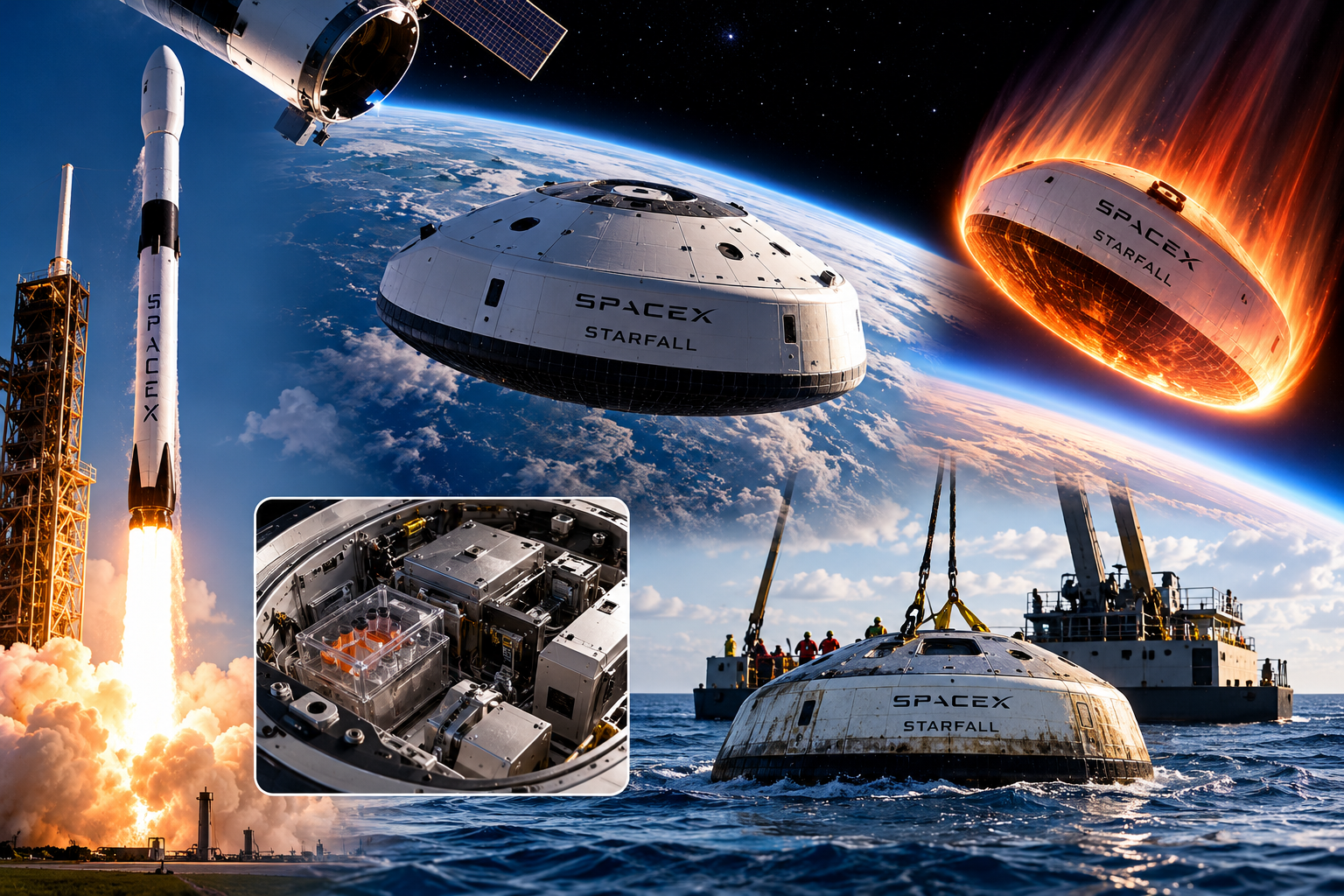
Spaceflight has a delivery problem with an unusual twist: getting something into orbit is no longer the only challenge. For researchers hoping to study materials or make products in microgravity, the experiment matters most when it comes back to Earth intact. That is the job SpaceX is designing its little-known Starfall capsule to do.
Starfall flew for the second time on Oct. 20, riding among 32 payloads aboard a Falcon 9 on the Bandwagon-5 rideshare mission. The rocket lifted off from Cape Canaveral Space Force Station in Florida at 7:04 a.m. EDT. Starfall was the final payload released, separating from the rocket’s upper stage two hours and 48 minutes after launch.
That release put the capsule on its way into orbit; it did not, by itself, demonstrate a return to Earth. The distinction matters. A spacecraft designed to bring research home must handle two very different environments: the near-weightlessness of orbit and the intense heating and forces of atmospheric reentry.
A laboratory that has to come home
SpaceX has offered few details about Starfall. In a public statement in June, the company said the capsule is intended to provide affordable, routine access to microgravity for research and in-space manufacturing. The basic idea is simple: let an experiment operate in orbit, then return its results for inspection on the ground.
Microgravity is not the absence of gravity. It is the condition experienced by objects in continuous free fall around Earth, where their shared motion makes them appear weightless. In that environment, fluids, crystals and other materials can behave differently from how they do in a laboratory on the ground. That makes orbit a useful place to investigate processes that gravity can complicate—but the findings are far more useful if scientists can retrieve the samples and examine them with Earth-based equipment.
Manufacturing adds another possibility. If a material or product can be made more effectively in orbit, a return vehicle could carry it back for testing or use. That is a prospect, not a result established by Starfall’s latest flight. The capsule’s value will depend on whether it can repeatedly deliver the same essentials: room for useful payloads, a controlled journey home and a safe recovery.
Small enough to ride-share, heavy enough to matter
An environmental assessment published by the Federal Aviation Administration in May gives a rare glimpse of the vehicle. Starfall is described as a disk about 10.2 feet (3.1 meters) across and 2.5 feet (0.75 meters) tall. It weighs roughly 4,600 pounds (2,100 kilograms) and is designed to return as much as 2,200 pounds (1,000 kilograms) of payload.
That shape and capacity point to a vehicle designed around cargo rather than passengers. The capsule shared its launch with satellites and another return vehicle, illustrating how rideshare missions can bundle very different space projects onto one rocket. Starfall’s companions included Varda Space Industries’ W-Series 7, an orbital mini-factory capsule intended to host production and bring products back to Earth, as well as Planet’s Pelican-12 Earth-observation satellite.
All 32 payloads were deployed over a period of about two hours, starting roughly 57 minutes after liftoff. Meanwhile, the Falcon 9’s first stage returned to a drone ship in the Atlantic about nine minutes after launch. SpaceX said the booster had flown 19 missions. The rocket’s landing is a familiar part of the company’s launch operations; Starfall’s more unusual test is whether a useful amount of cargo can make the full round trip.
The return is the real test
Starfall first flew on June 23, on a dedicated demonstration mission intended to show that it could fly in a controlled way and withstand atmospheric reentry. The company has not made many public details available, and the supplied information about the Oct. 20 mission does not report a return or recovery. For now, the launch establishes that Starfall has flown a second time—not that its cargo-return system has become routine.
That uncertainty is part of what makes the capsule worth watching. Reusable rockets have made reaching orbit more familiar; dependable return vehicles could make the journey back just as ordinary as the journey up. If that happens, orbit could begin to feel less like a remote destination and more like a workshop with a reliable shipping service. Starfall’s most important moment may not be its departure, but the day an experiment it carried comes home.