
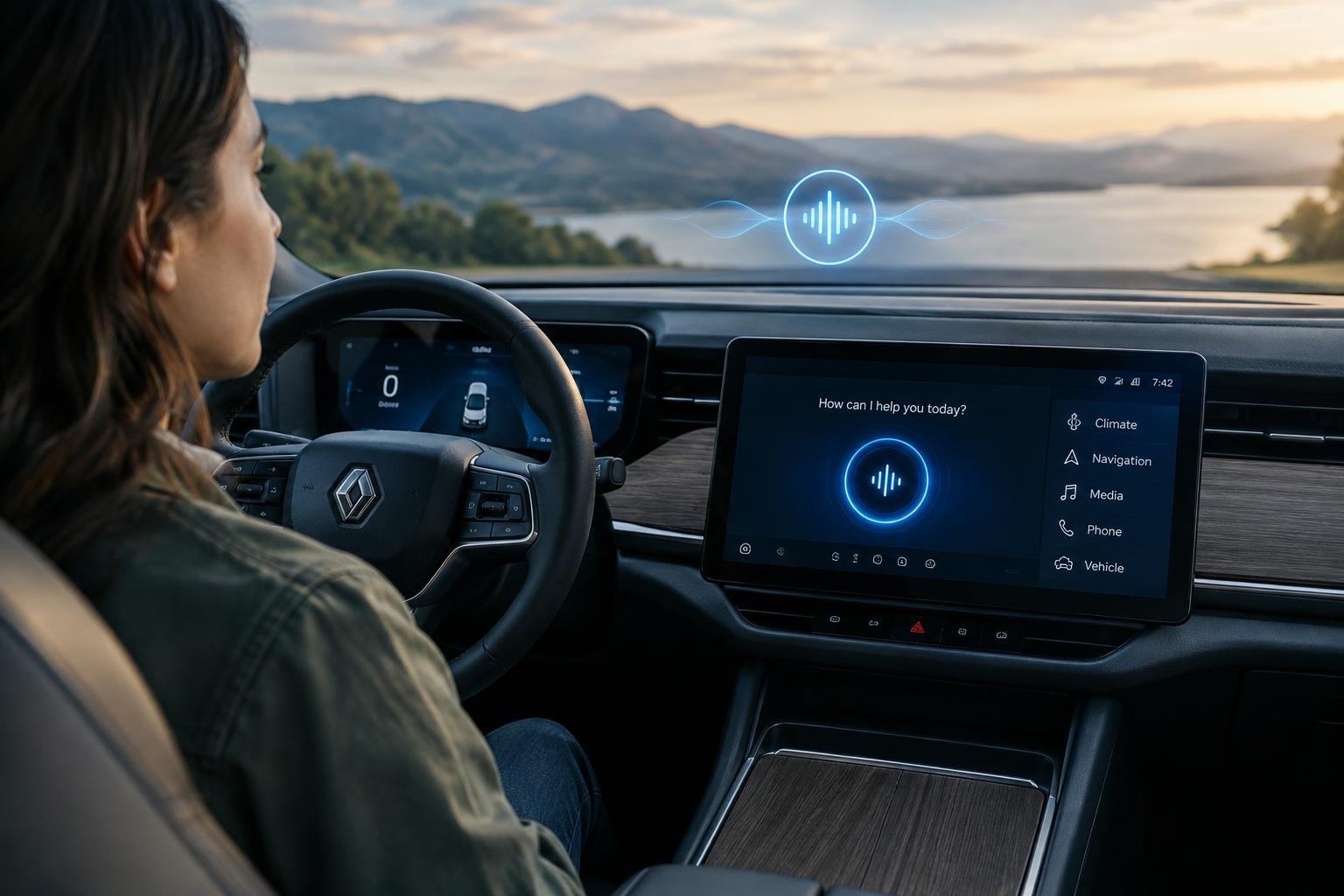
When a driver asks a car to do something, the request has to travel somewhere: from the spoken words to the right software, then to the vehicle function that can act on them. Rivian wants that behind-the-scenes handoff to become part of its partnership with Volkswagen Group. Its latest move is to license elements of its AI voice-assistant technology to VW.
The companies have not said which Volkswagen models will get the assistant, or disclosed licensing fees and payment terms. The announcement is less a promise about a particular dashboard than a sign that their collaboration is reaching beyond the basic architecture of a car’s electronics.
From car controls to software platform
Rivian’s assistant lets drivers and passengers speak to the vehicle and control some of its functions. The company says it has built an in-house framework that interprets what a person wants and directs the request to the relevant part of the car’s software. In practical terms, that is a little like a smart switchboard: the system must make sense of a request, then find the right destination.
That distinction matters. A voice interface is the part people hear; the software framework underneath determines what the vehicle can do with their words. Rivian CEO RJ Scaringe has said the framework could eventually support AI agents from other companies, including Anthropic. That is a potential direction, not a confirmed feature of Volkswagen vehicles.
Rivian spent two years developing the assistant before unveiling it last year. It began arriving in the company’s R1S SUV and R1T pickup in May 2026, followed by the midsize R2 SUV in October. The addition to the VW venture extends the technology’s possible reach, but the automaker has not identified a launch model for the assistant.
A bigger bet on the car’s digital foundations
The assistant is being added to a joint venture that began with a more fundamental task: bringing Rivian’s electrical architecture and software to Volkswagen’s next generation of vehicles. The venture, established in 2024 and operating through an independent company from November that year, was initially valued at up to $5 billion. VW later raised its investment commitment to as much as $5.8 billion by 2027.
The first Volkswagen vehicle slated to use Rivian’s software and electrical architecture is the low-cost ID EVERY1, a small four-door hatchback. That makes it a possible home for the assistant, but the companies have not confirmed that it will be included. The distinction is important: sharing a technological foundation does not automatically mean every feature will appear in every vehicle built on it.
Rivian’s argument for its approach is that software works better when it is designed alongside the hardware it controls. In an overhaul of its R1T and R1S, the company changed components ranging from the battery pack and suspension to sensors and electronics. It reduced the number of electronic control units—the small computers that manage vehicle systems—from 17 to seven, while also cutting wiring.
Fewer separate computers can give engineers a more unified platform for software updates and new functions. Rivian says control over components such as computing, sensors, displays and sound lets it send updates across more of the vehicle than basic infotainment fixes. That does not guarantee a better experience, but it can make the car’s digital systems less like a collection of unrelated gadgets.
The test is what drivers can actually do
Volkswagen has struggled to deliver the kind of software-focused vehicles offered by some competitors, which helps explain the appeal of Rivian’s technology. For Rivian, licensing the assistant is also evidence that its internally developed platform may have value beyond its own vehicles. The companies have not released details showing how the licensed elements will be adapted for VW cars.
Drivers will ultimately judge the partnership not by how many computers sit beneath the dashboard, but by whether the car understands a request and responds reliably. A voice assistant can make a complicated software system feel simple—or expose every point where it falls short. The most consequential part of this deal may be invisible: the system that decides what a car’s voice should be able to do.