
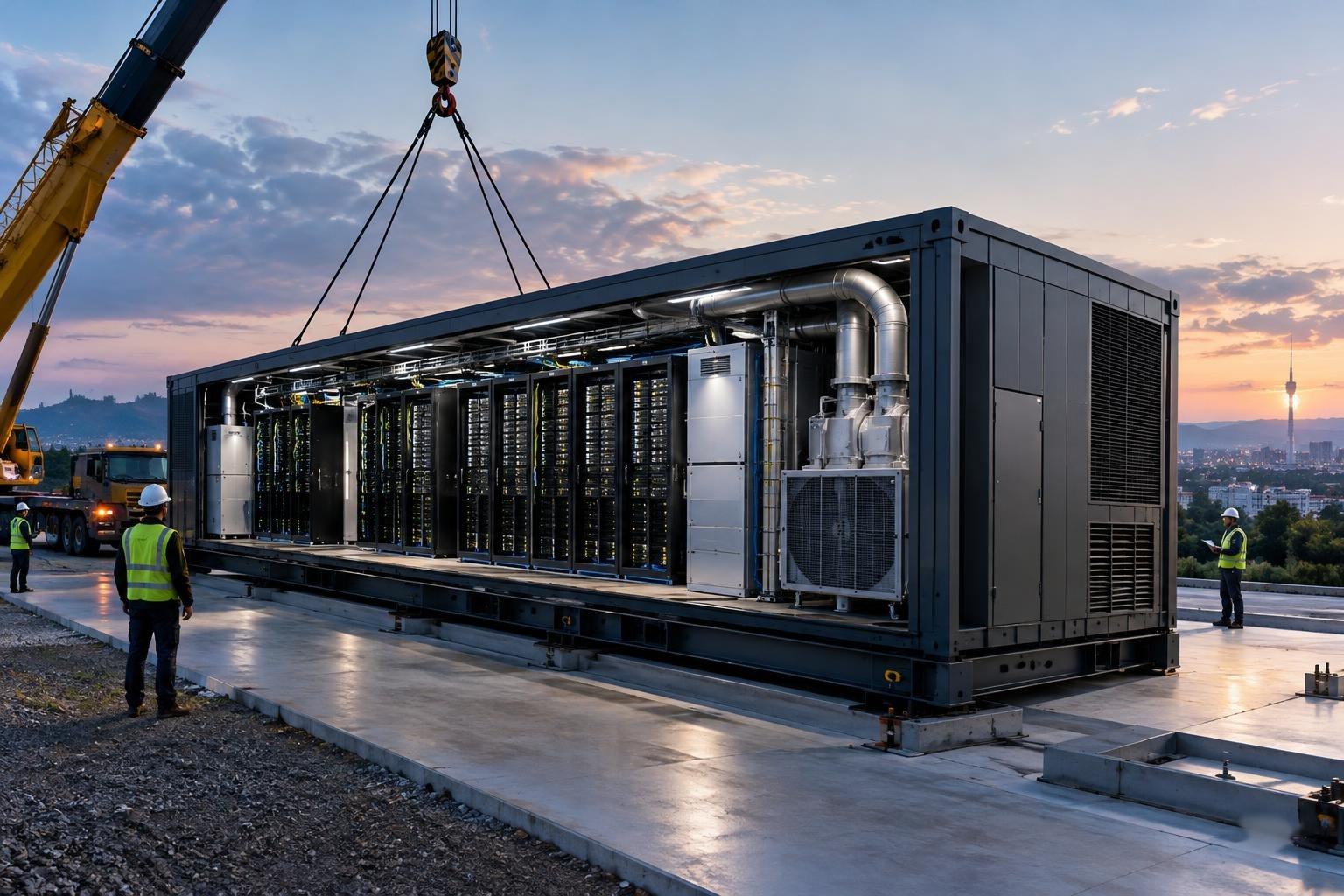
AI systems may be built from software, but the machines that train and run them need very physical things: racks, networks, cables and cooling. Getting those pieces to work together at a new site can take months. Nvidia’s proposed shortcut is to arrive with much of that complexity already assembled.
At GTC Berlin, the company introduced DSX Pod, a containerized module containing seven Vera Rubin NVL72 racks, with networking, cabling and cooling installed. Nvidia says that at a prepared site, deployment could shrink from roughly six months to as little as 14 days.
The intriguing idea is not simply a faster data center. It is a change in what a data center can be: not only a building assembled piece by piece, but a repeatable product delivered in a known configuration.
The hard part is making everything work together
A large computing facility is a chain of dependencies. Servers need connections to one another; equipment generates heat that must be carried away; and the site must be ready to support the installation. When these elements are planned and fitted separately, delays in one part can hold up the rest.
Nvidia describes DSX Pod as prebuilt, pre-plumbed, tested and validated. In practical terms, that means more of the work happens before the module reaches its destination, rather than being coordinated from scratch at the site. The company calls the pod a building block for what it terms AI factories—facilities designed to deliver computing capacity for AI.
The distinction matters. Fourteen days is Nvidia’s estimate for deployment at a prepared site, not a promise to create a complete data center from empty land in two weeks. The announcement does not remove the need to prepare a location or establish the broader infrastructure required to operate it. It aims to make the on-site assembly stage faster and more predictable.
Modularity trades custom work for repeatability
That trade-off could appeal to organizations whose needs do not fit neatly into a conventional, large-scale build. IDC analyst Ashish Nadkarni identified possible uses including physically isolated sovereign AI deployments, smaller installations tailored to particular workloads, and edge environments—places where computing is needed nearer to users or equipment.
A standardized module could also make it easier to add capacity in stages: deploy one unit, then expand as demand grows. Nvidia says the design is intended to help organizations bring computing online at the hundreds-of-megawatts scale more quickly. That is an ambition for large deployments, not a stated capacity for a single pod.
Nvidia is working with 17 partners to bring DSX Pod to market, including Bull, Dell Technologies, HPE, Lenovo, Eaton, Schneider Electric and Vertiv. The company says it expects the offering to become available in early 2027. A partner network matters because a ready-to-install design depends on more than the computing racks: equipment, power and cooling systems, and deployment expertise all have to fit together.
Faster assembly does not make supply chains disappear
There is a catch in the promise of a repeatable module: standardizing the installation helps only if the components can be made and supplied in sufficient numbers. Nvidia paired its announcement with plans to expand several parts of its manufacturing pipeline. With partners, it aims to increase substrate capacity 2.5 times over three years, grow advanced packaging capacity by more than 300% by 2028, and multiply optical-engine capacity for co-packaged optics 15 times by mid-2027, with another doubling targeted by the end of 2028.
Those plans point to a broader bottleneck. Computing hardware depends on layers of production beyond the chips themselves, including packaging and the components that move data between systems. A preassembled pod can reduce the amount of work at a construction site; it cannot, by itself, guarantee that every part of the supply chain keeps pace.
If the design works as Nvidia intends, the data center’s identity may begin to shift—from a one-off construction project toward a repeatable unit of computing infrastructure. The most revealing measure will not be the two-week installation claim alone, but whether these ready-made blocks can be produced, connected and powered wherever demand arises. The future AI factory may arrive less like a building and more like a machine—but it will still need a place to plug in.