
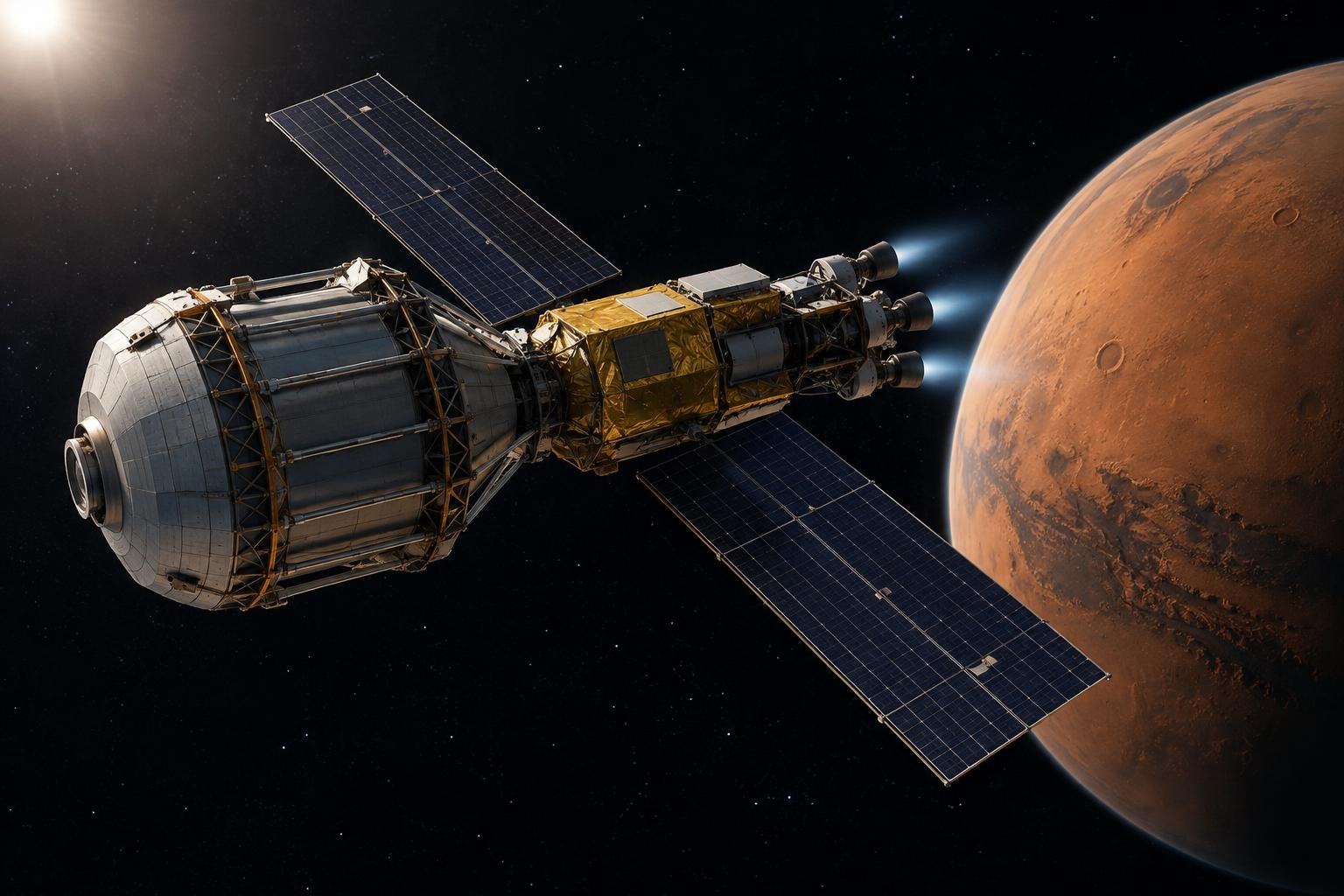
What happens when a spacecraft needs more power than sunlight can reliably provide? NASA’s answer is taking shape in a machine that will turn heat from a nuclear reactor into electricity—and, if plans hold, carry that technology beyond Earth orbit.
NASA has announced progress on the nuclear power module for Space Reactor-1 (SR-1) Freedom, a mission intended to demonstrate nuclear electric propulsion in deep space. The latest step is a contract arrangement for Sierra Lobo Inc. to supply the module’s power-conversion system. The spacecraft is targeted to launch in late 2028.
Turning reactor heat into spacecraft power
The power system’s job is not to push the spacecraft directly with reactor heat. Instead, it will convert that heat into electricity, which the spacecraft can use for its electric-propulsion demonstration and other systems. That distinction matters: the reactor is the energy source, while the propulsion system uses electrical power to move the vehicle.
Sierra Lobo’s contribution is a closed Brayton cycle system. In a typical Brayton cycle, a gas is heated, expands through a turbine and helps drive a generator; the gas then cools and is compressed to repeat the loop. “Closed” means the working gas circulates within the system rather than being continuously taken in from outside and expelled. The NASA announcement identifies the system’s role but does not provide its detailed design or performance figures.
The conversion equipment is only one half of the nuclear power module. The Department of Energy’s Idaho National Laboratory is designing and developing the fission reactor that will provide the heat. Once integrated, reactor and converter are meant to supply the electricity required for SR-1 Freedom’s demonstration.
Why use nuclear power beyond Earth?
Solar panels are a proven way to power spacecraft, but sunlight weakens with distance from the Sun and can be unavailable in shadow. A fission reactor offers a different source: energy released by splitting atomic nuclei, rather than energy collected from sunlight. That makes nuclear systems an attractive option for missions that need dependable power in places where solar panels may not be enough.
Electric propulsion also trades a sharp shove for a long, steady push. Compared with conventional chemical rockets, electric systems can use propellant efficiently, but generally produce much lower thrust. That makes them suited to building up speed over time in space—not to lifting off from a planet. SR-1 Freedom is intended to test this pairing of a compact fission power source with electric propulsion in deep space.
The mission is also planned to carry SkyFall: three Mars helicopters evolved from NASA’s Ingenuity design. They are intended to gather scientific data, help demonstrate exploration zones and identify possible water sources. Their work would extend the aerial exploration approach pioneered by Ingenuity, while the spacecraft carrying them tests a power technology with ambitions beyond this one mission.
A test with careful boundaries
NASA and the Department of Energy say safety reviews and oversight are built into the spacecraft’s development. Crucially, the reactor is planned to remain inactive until SR-1 Freedom has left Earth orbit. That is a design boundary, not a claim that nuclear missions are risk-free: the agencies describe a continuing process focused on hazards, failure tolerance and nuclear safety.
The current contract action advances development; it does not mean the power module is complete or the mission’s schedule is guaranteed. NASA says the work is being carried out under a spaceflight systems contract awarded in 2024, with development, testing and operations support at NASA’s Glenn Research Center in Cleveland.
If SR-1 Freedom flies as planned, its importance will reach beyond one Mars-bound mission. NASA sees the work as a step toward future fission-powered systems, including power for a lunar base during long periods of darkness or in locations poorly served by sunlight. For now, the central challenge is more focused: prove that reactor heat can become useful spacecraft electricity, safely and far from home. In deep space, the ability to bring your own power source could change what is possible to explore.