
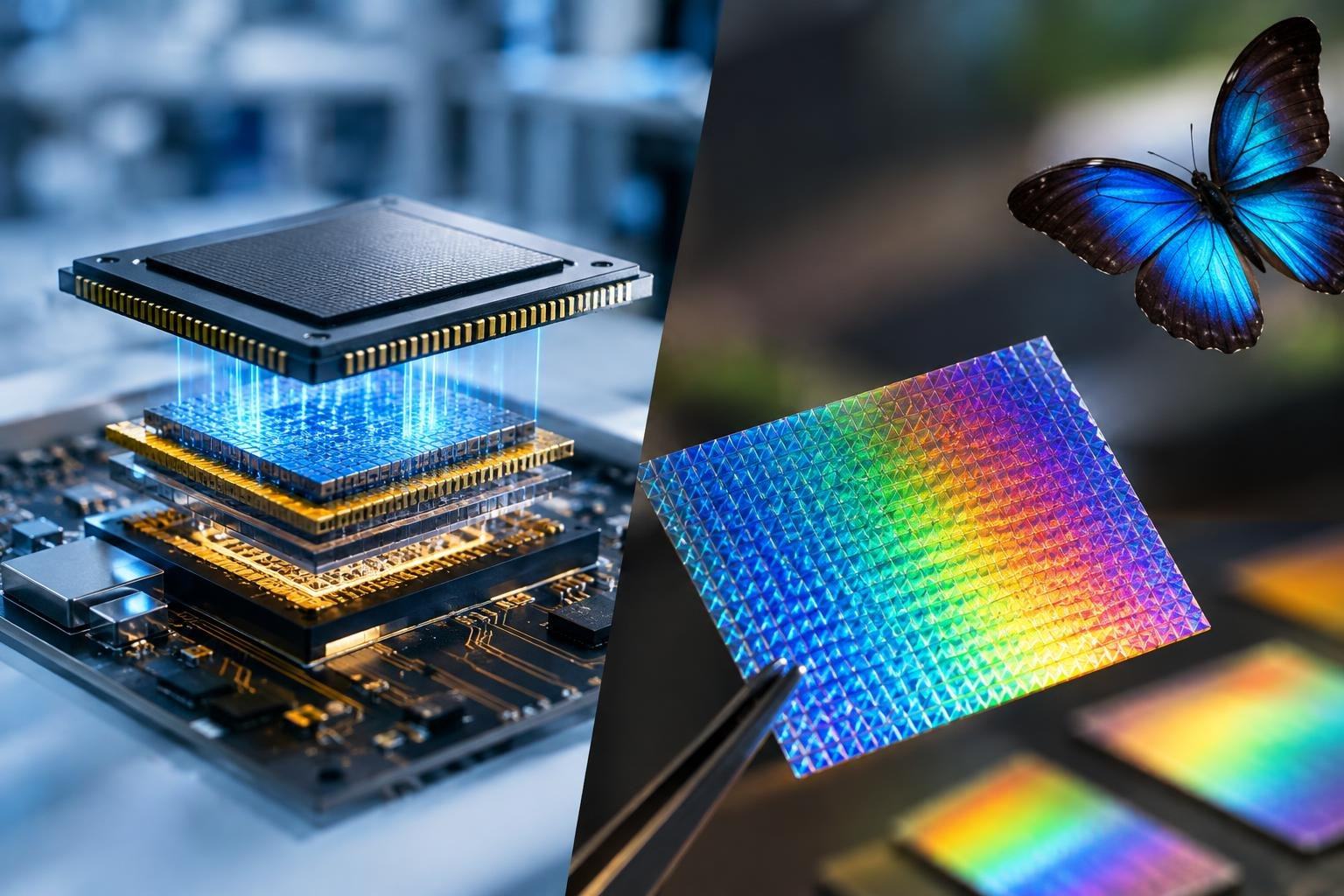
A powerful AI chip needs more than fast calculations. It also needs a steady stream of electricity—and getting that power to the chip can waste a significant amount along the way. Meanwhile, the colors on paper and painted surfaces often have a different weakness: they can fade as sunlight alters the pigments that create them.
Researchers at South Korea’s KAIST are tackling these two problems from unexpected directions. One group is redesigning how electricity reaches a chip; another is using tiny physical structures to create color without dye. The work highlights a broader engineering idea: sometimes performance depends not on adding more, but on losing less.
Putting the power converter beneath the chip
Inside an AI server, electricity passes through several stages before reaching a processor at the low voltage it requires—around one volt, according to Professor Kim Sang-hyun of KAIST’s Department of Electrical Engineering. Each conversion and connection can dissipate energy as heat. Kim estimates that 30% to 40% of total power may be lost in delivery, with the proportion potentially rising as chip power demands grow.
The basic physics is familiar from the electricity grid. For a given amount of power, lower voltage means higher current, and current flowing through resistance produces heat. That is why electricity travels long distances at high voltage before being stepped down near homes and businesses. AI servers face a miniature version of the same challenge.
In conventional layouts, voltage-regulating components sit beside the processor. Kim’s team proposes placing them directly beneath the chip. Power can travel to that point at higher voltage, then be converted close to where it is needed. The shorter route for low-voltage electricity could reduce losses in the connections and components between converter and processor.
Gallium nitride, or GaN, is central to the approach. Voltage converters rely on switches that rapidly turn electrical flow on and off; resistance in those switches generates heat. Kim says GaN can offer lower resistance than conventional silicon in this role, helping limit wasted energy.
The team reports that its approach could raise power-delivery efficiency from the 50% range to between 85% and 95%. That is a research result, not a guarantee of what a finished server will achieve: the figure concerns electricity delivered to the chip, not the overall efficiency of an AI system. Still, even a partial reduction in these losses could matter as individual chips demand more power.
The hard part is building it at scale
Making the layout practical requires bringing together materials and manufacturing processes that are not yet routinely combined. The computing chip is made using silicon processes, while the voltage-regulating device uses GaN. Those components must then be connected and packaged in a way that supports stable power delivery.
Kim says foundries do not yet sufficiently support the processes the design requires. His team plans further lab work to demonstrate performance and assess effects across a full circuit and system. It is also pursuing technology transfer, while keeping open the possibility of a faculty-led startup if more development is needed before companies can adopt the technology.
Kim plans to present the power-delivery work at the 2026 K-Premier Deep Tech Festa in Seoul on October 29, where he hopes to meet chipmakers and packaging companies. The packaging challenge is not a footnote: putting a converter beneath a processor depends on a way to combine the parts reliably.
Color made by shape, not pigment
A separate KAIST project takes a similarly structural approach to a very different problem. Professor Kim Shin-hyun, of the university’s Department of Biological and Chemical Engineering, creates color by etching tiny hemispherical patterns into transparent material. The features are about one-tenth the thickness of a human hair.
Instead of relying on pigment molecules, the material’s microscopic geometry produces its color through the way it interacts with light. Because the color comes from a physical structure, it avoids the particular fading mechanism in which ultraviolet exposure changes pigment molecules. The researchers’ qualification is important: the color lasts as long as the structure remains intact.
The team sees potential applications ranging from anti-counterfeiting to art materials. Those uses are still possibilities, not proof that the technique is ready to replace ordinary inks or paints. But both projects invite the same question: what if the best way to improve a technology is to rethink the route—of electricity through a chip, or of light through a material?