
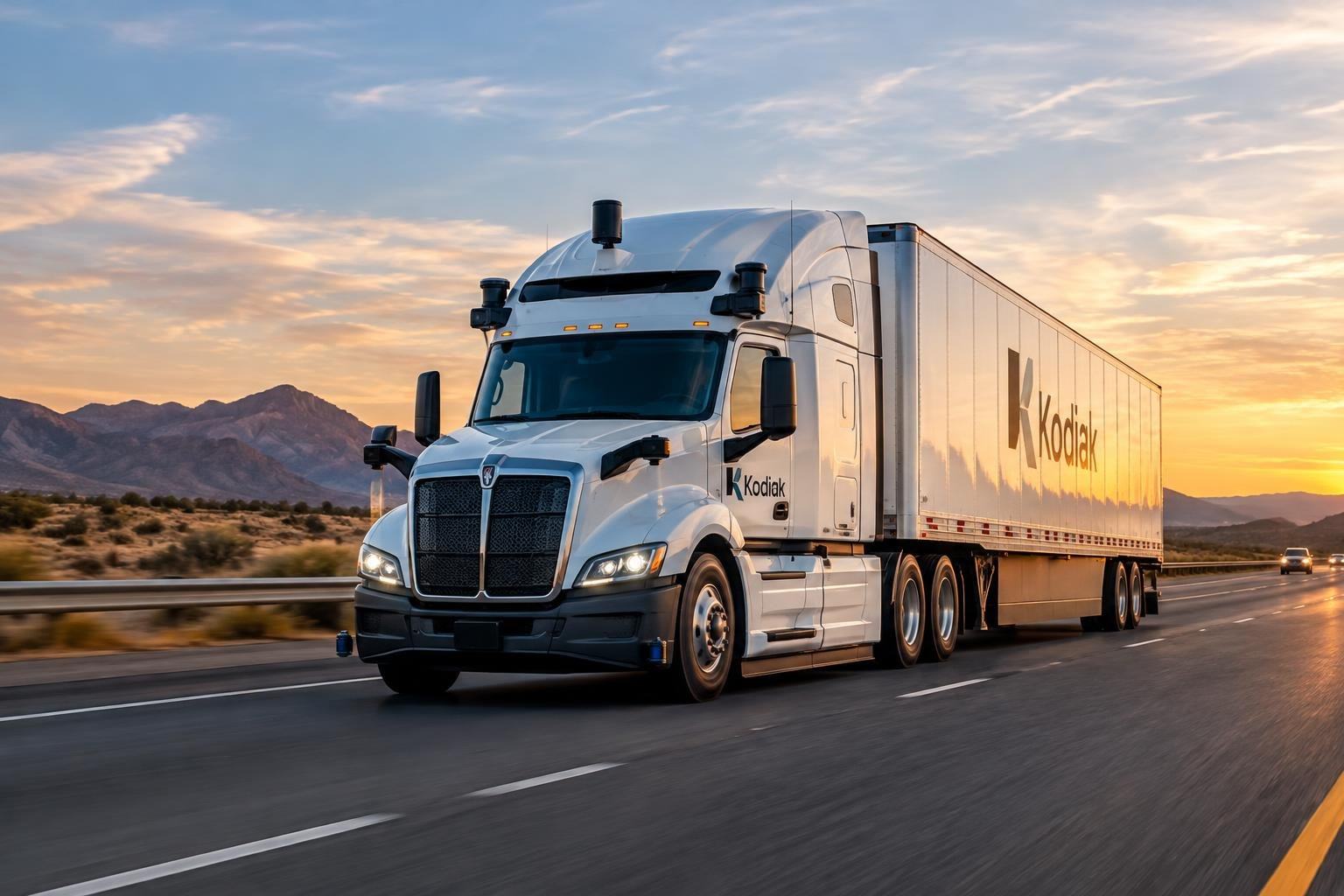
A truck carrying fresh produce can cover hundreds of miles between farms, distribution centers and grocery stores. The difficult question for driverless trucking is not just whether a computer can steer one down a highway. It is whether an established carrier will trust the technology enough to build it into everyday freight operations.
Kodiak AI has landed a significant test of that proposition. The company will supply 75 self-driving trucks to DTL Transport, with deliveries scheduled to begin in 2028. Announced on October 28, the binding deal is Kodiak’s first commercial agreement for driverless big rigs intended for public highways.
A shift from proving the system to selling it
The contract is notable not only for its size but for how the two companies plan to work together. Kodiak’s current highway business largely follows a trucking-as-a-service model: Kodiak owns and operates the trucks, then carries freight for customers. DTL’s agreement instead points toward driver-as-a-service, in which the customer owns and operates the trucks and pays Kodiak to license its autonomous-driving technology.
That difference changes the shape of the business. Running a fleet means managing trucks and freight operations as well as developing software. Licensing the system could let Kodiak focus on its technology while carriers handle the vehicles and routes they already know. But the model depends on customers being willing to take on that responsibility—and on the system fitting into their operations.
DTL is a midmarket carrier that transports produce and other goods to grocery chains. It plans to use the trucks on multiple interstate routes, beginning with Dallas to El Paso and Interstate 20 between Dallas and Atlanta. Kodiak has already tested and operated on those routes. The companies’ relationship began with a pilot in California, where a Kodiak truck carried perishable goods roughly 225 miles between Fresno and Los Angeles, with a human safety operator behind the wheel.
The highway milestone still lies ahead
The DTL deal does not mean driverless trucks are already operating without people on public highways. Kodiak plans to remove its human safety operators from the cab in December, beginning a driverless highway service that is expected to carry Ikea goods on Interstate 45 between Dallas and Houston. That upcoming step and the DTL contract are related, but distinct: one is a planned operating milestone; the other is a commercial commitment whose deliveries start in 2028.
There is also a useful distinction between highway trucking and Kodiak’s existing work with Atlas Energy Solutions. Atlas has owned and operated 35 Kodiak-equipped trucks since 2024, but they work off-road in the remote Permian Basin of West Texas. Kodiak’s CEO, Don Burnette, said the company is on track to have as many as 100 of those trucks in service by mid-2027. That earlier contract shows the technology already has a commercial customer; DTL is the first binding deal for its use on public highways.
For Kodiak, the sequence reflects a practical route to adoption: operate trucks itself, demonstrate the system and its integration, then persuade carriers to take the wheel as owners. Its trucking-as-a-service operations currently haul freight on three Texas routes for customers including Charger USA, Roehl Transport and Werner Enterprises. Burnette has described those operations as still being in the pilot stage.
What 75 trucks could mean
The companies have not disclosed the value of the DTL contract. Kodiak’s 2025 investor presentation forecast annual recurring revenue of $150,000 to $190,000 per truck, based on assumptions including a licensing fee of about 97 cents per mile and 225,000 miles driven annually. If those projections hold and all 75 trucks are delivered, the deal could eventually represent at least about $11.2 million in recurring annual revenue. That is an estimate based on Kodiak’s assumptions, not a reported contract value.
The number is a business projection, not a verdict on whether driverless freight has proved itself. Kodiak’s shares have fallen 87% from their opening-day price after the company went public in September 2025, making a firm customer commitment a meaningful benchmark—but not proof that the technology will scale smoothly.
For now, the most revealing measure may be less dramatic than a truck crossing a state line with no one in the cab. It is whether a carrier like DTL can make autonomous trucks part of the ordinary machinery of moving food and goods. The road to driverless freight may run not through one spectacular trip, but through the quiet handoff from technology developer to trucking company.