
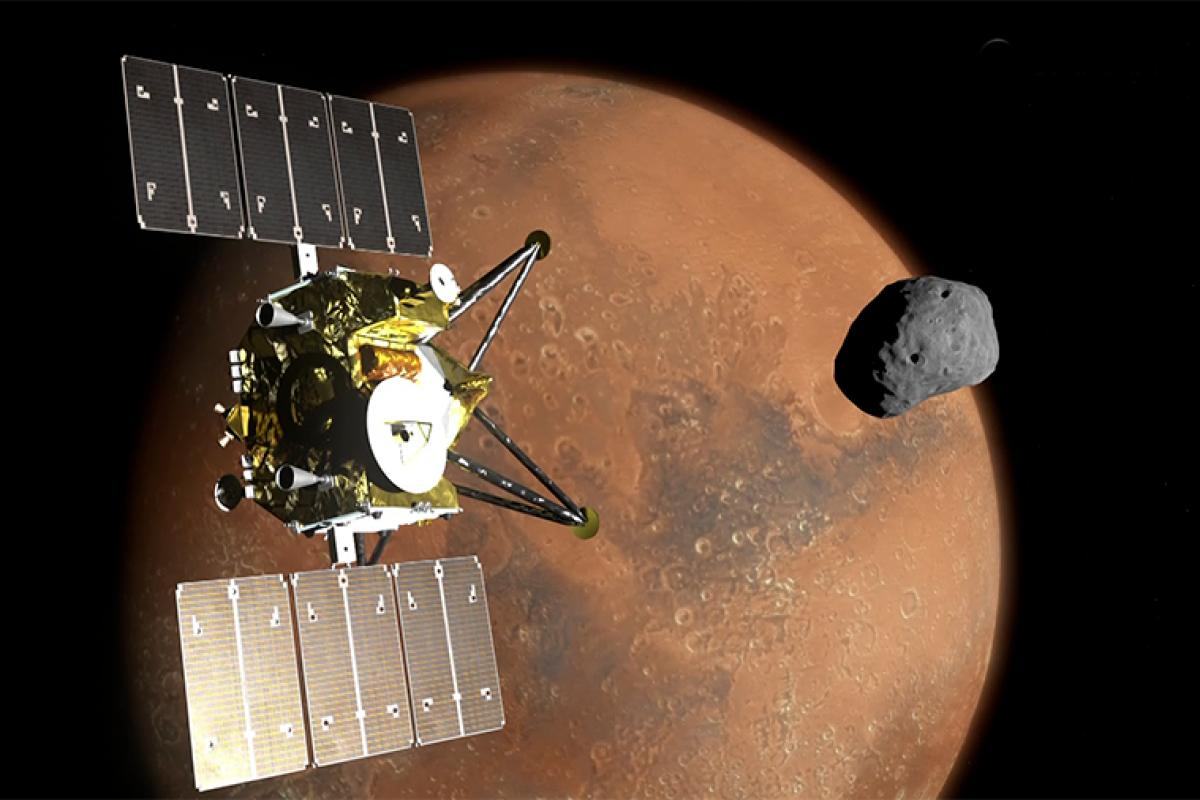
Japan’s Martian Moons eXploration mission is headed for Mars after launching successfully from Tanegashima Space Center on Oct. 19. The spacecraft, known as MMX, lifted off aboard an H3 rocket at 3:41 p.m. EDT, or 4:41 a.m. on Oct. 20 in Japan, and separated from the rocket’s upper stage about 71 minutes later. Led by the Japan Aerospace Exploration Agency (JAXA), MMX is designed to study both of Mars’ moons, Phobos and Deimos, and attempt a first: landing on Phobos, gathering samples and bringing them back to Earth. The mission’s findings could help resolve a long-running debate about how the two moons formed. The launch marked the 10th flight of Japan’s H3 rocket, a two-stage vehicle developed jointly by JAXA and Mitsubishi Heavy Industries. The 63-meter rocket followed a planned ascent over the Pacific. It discarded its four solid boosters in pairs shortly before the two-minute mark, then shed its payload fairings, exposing MMX to space. The rocket’s first stage used two LE-9 engines burning liquid hydrogen and liquid oxygen. After the first stage separated, the upper stage carried out further engine burns, including a trans-Mars injection maneuver about an hour after liftoff. That burn lasted roughly six minutes and 25 seconds and brought the spacecraft to a reported maximum velocity of about 38,858 kilometers per hour. MMX then separated on schedule, prompting cheers in mission control, according to the launch webcast. The spacecraft will spend about 10 months traveling to Mars, with arrival planned for August 2027. It is expected to enter a quasi-satellite orbit around Phobos, moving in the space around the moon as Phobos orbits Mars. MMX is scheduled to remain in the Martian system for roughly three years, with much of its science work focused on the 22-kilometer-wide Phobos. The mission also carries IDEFIX, a rover developed through a partnership between the space agencies of France and Germany. Its planned deployment to Phobos is set for late 2028 or early 2029. After mapping the moon and choosing suitable sites, MMX is expected to make two touchdowns to collect and store samples. Following the collection phase, the spacecraft is planned to return briefly to its orbit around Phobos before moving into a more elongated orbit around Mars. That path will allow it to make a series of flybys of Deimos, the smaller of the two moons, which is about 14 kilometers across. MMX is scheduled to leave Mars for Earth in November 2030. If the mission proceeds as planned, its sample capsule will land in Australia in 2031. The samples may help distinguish between two competing explanations for the moons’ origins. Their nearly circular orbits around Mars are consistent with the idea that a large impact broke material from the planet, which later gathered into moons. But Phobos and Deimos are irregular and potato-shaped, and their composition, as inferred from telescopic observations, has also been cited as evidence that they could be asteroids captured by Mars’ gravity. Researchers plan to examine the returned material’s composition and mineralogy and compare its chemical signatures with those of Martian rocks and asteroid material. The samples, together with observations gathered by MMX, could provide evidence to clarify Phobos’ history and offer clues about the early solar system. The mission is an international effort involving JAXA, NASA and the European Space Agency, as well as U.S. and European companies. NASA supplied a gamma-ray and neutron spectrometer built by Johns Hopkins Applied Physics Laboratory, a pneumatic sampler built by Honeybee Robotics, and communications support through its Deep Space Network. NASA has also committed about $87 million through the mission’s end. At least 15% of the planned 10-gram sample is reserved for NASA, which will maintain the material at Johnson Space Center in Houston. A previous attempt to return material from Phobos, Russia’s Phobos-Grunt mission, launched in 2011 but failed to leave Earth orbit and later fell back to Earth. MMX now begins a journey that, if successful, would deliver the first samples collected from the Martian moon to laboratories on Earth. Source: https://www.space.com/space-exploration/launches-spacecraft/japan-launches-historic-mmx-sample-return-mission-to-mars-moon-phobos
Japan Launches MMX Mission to Explore Phobos and Deimos
Japan’s MMX spacecraft is on its way to Mars after a successful H3 rocket launch, beginning a mission that aims to collect samples from Phobos and return them to Earth in 2031.
This image may have been generated, edited or modified using AI and may contain inaccuracies. © BadgerHunt. All rights reserved.
Source
Read source article