
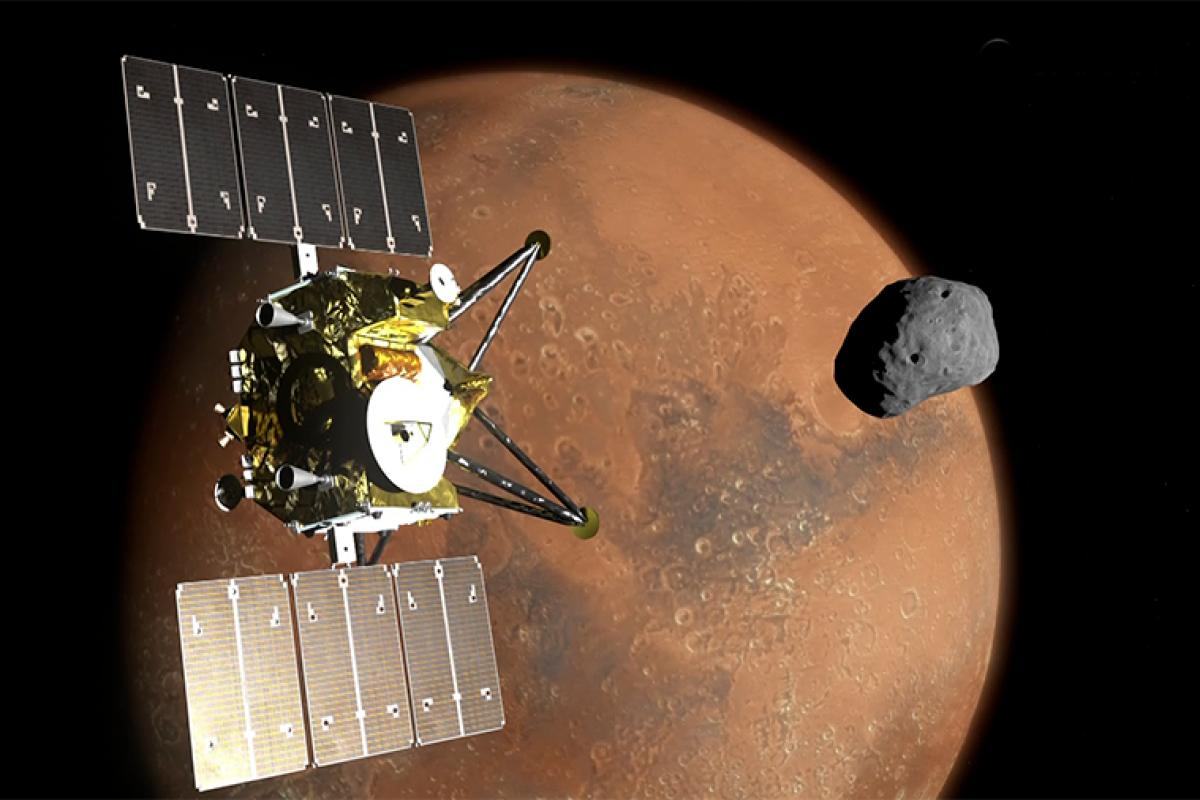
Phobos may be a captured asteroid—or a fragment born from a violent event around Mars. Japan’s new Martian Moons eXploration mission, or MMX, is setting out to investigate that mystery by bringing a piece of the moon back to Earth, where scientists can examine it in detail.
The spacecraft lifted off Monday from Tanegashima Space Center in southern Japan, beginning an expedition expected to last five years. Its first destination is Mars, a journey of about 10 months. If the mission succeeds, it will deliver the first samples ever collected from a moon of Mars.
A heavyweight launch for a distant destination
MMX rode into space on Japan’s H3 rocket, the country’s flagship launch vehicle. For this flight, the 63-metre rocket used four solid-fuel boosters, powerful main engines and an extended nose fairing to accommodate Japan’s heaviest and most ambitious interplanetary spacecraft to date.
The spacecraft weighed nearly 4.5 tonnes at launch, with propellant making up about two-thirds of that mass. After the rocket’s upper stage accelerated it to more than 24,000 miles per hour, MMX separated from the launcher roughly 71 minutes after liftoff—moving fast enough to escape Earth’s gravity and head for Mars.
JAXA, Japan’s space agency, reported that the spacecraft had contacted controllers and deployed its solar panels after separation. Mission project manager Yasuhiro Kawakatsu said it was in a stable condition. That marks a successful start, but the most demanding parts of the journey still lie ahead: reaching Mars, operating around its moons and carrying out the sample-return plan.
What a grain of Phobos could reveal
Phobos is the larger of Mars’s two moons, but it is tiny compared with Earth’s Moon. Its irregular shape and surface make it unlike the familiar, round moons that formed from large, orderly disks of debris. One possibility is that Phobos is an asteroid captured by Mars’s gravity billions of years ago. Another is that it formed from material thrown into orbit by a major impact on the planet.
Those origins would leave different clues in the moon’s composition. A sample examined in laboratories on Earth could help researchers test whether Phobos resembles asteroid material or bears the chemical signatures expected of debris linked to Mars. The result would shed light not only on the moon itself, but also on the history of the Martian system and the processes that shaped the early Solar System.
Spacecraft can study distant bodies with cameras and instruments, but returning material offers a different level of scrutiny. Scientists can apply a range of laboratory techniques to a carefully preserved sample, including methods that are difficult or impossible to carry out on a spacecraft. The value of the mission therefore rests not just on reaching Phobos, but on getting its material safely back for analysis.
Japan’s sample-return experience
MMX builds on Japan’s experience with the Hayabusa and Hayabusa2 missions, which brought back pristine samples from asteroids. Those projects demonstrated how a robotic spacecraft can travel to a small, distant body, gather material and return it to Earth. Phobos presents a new challenge: it circles Mars, so the mission must work in the environment of another planet as well as at its moon.
Japan’s science minister, Yoshihiro Seki, described MMX as a challenging effort to achieve the world’s first sample return from the Martian moons. Its success could strengthen the country’s capabilities in deep-space exploration while giving planetary scientists a rare physical record of a world that has so far been studied from afar.
For now, MMX has only begun its long voyage. But the spacecraft’s departure opens a new route to understanding how Mars acquired its moons—and whether one of them began its life somewhere else.