
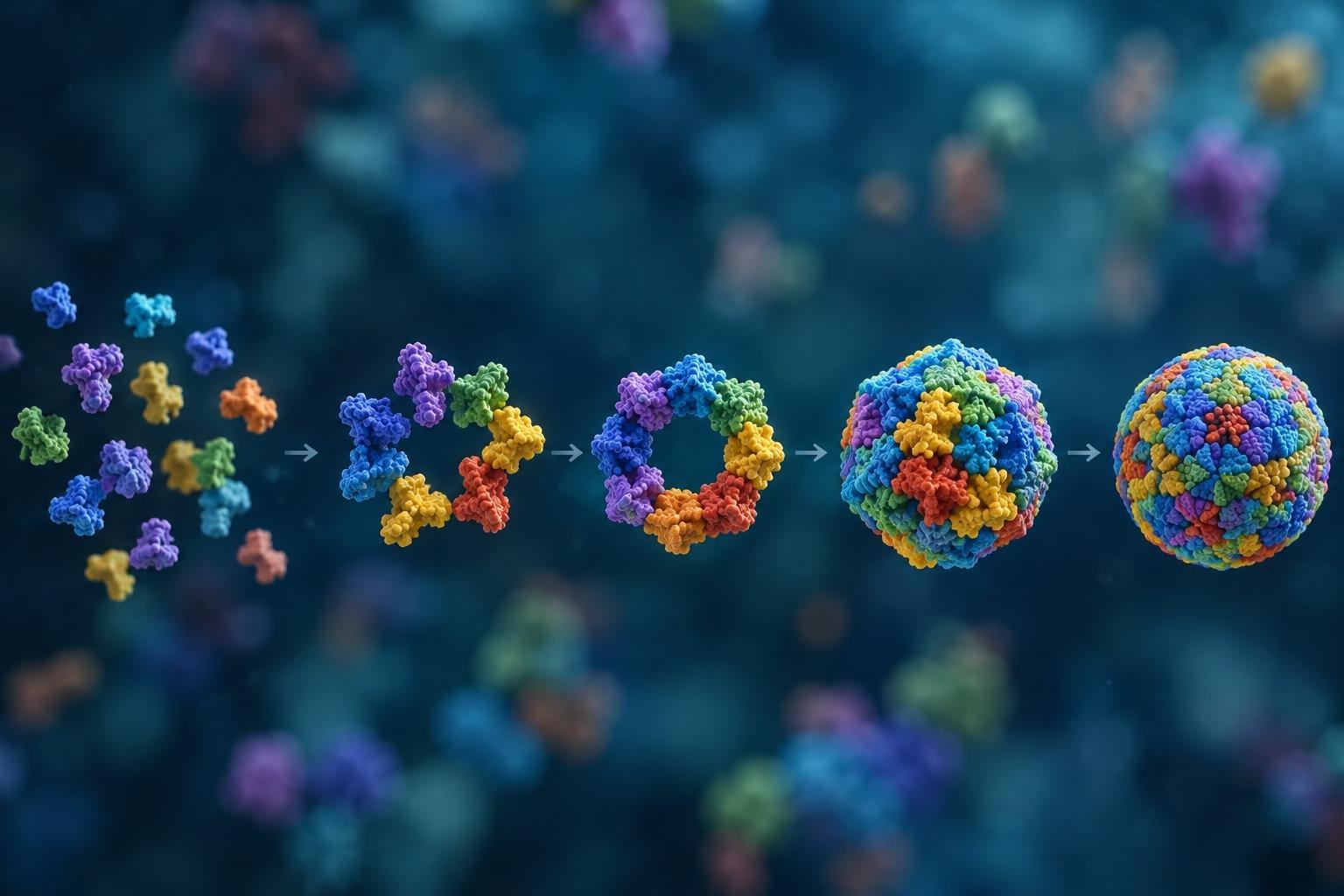
Imagine trying to assemble a tiny, intricate structure with no instructions and no hands—only pieces that bump into one another, stick briefly, and sometimes fall apart. That is the puzzle facing many viruses as they build the protein shells that protect their genetic material. Researchers at the University of Oxford have now watched a virus-like particle take shape molecule by molecule, revealing how a process full of wrong turns can still reach a reliable result.
The study, published in Nature, offers a rare view of the fleeting stages between loose protein components and a finished shell. The team found that assembly is not a smooth, predetermined march. Instead, it depends on a combination of reversible mistakes and stable checkpoints that gradually narrow the route to completion.
Watching a shell take shape
A virus’s protective casing, called a capsid, is built from protein units. In many viruses, those proteins can organize themselves without an external machine directing their placement. But the intermediate arrangements are often short-lived and scarce, making them difficult to catch. Researchers have commonly had to compare starting materials and finished particles, then infer what happened in between.
To see more of the process directly, the Oxford team studied an engineered virus-like particle made from 60 protein units. They combined mass photometry—a method that estimates the mass of individual molecules from the light they scatter—with a technique for keeping particles confined and observable. As proteins joined a growing particle, researchers could track changes in its mass, effectively following its construction over time.
The result was more than a before-and-after comparison. It let the team observe intermediate stages as they appeared and work out how the interactions between building blocks shaped the particle’s growth. The experiment involved an engineered particle, so it does not mean every virus assembles in precisely the same way. But it provides a detailed look at the physical rules that can make self-assembly work.
The value of getting it wrong
At first, proteins make weak connections. If they meet in an unhelpful arrangement, those bonds can break, freeing the pieces to try again. This flexibility matters: with many possible ways to connect, a rigid early attachment could trap the assembly in a dead end.
The turning point comes when five of the larger protein building blocks join into a closed, pentagonal ring. The researchers identified this as the first especially stable structure in the process. Once it forms, the particle has a foothold: later stable stages need fewer additional building blocks, and growth can proceed more quickly.
It is a little like assembling a structure from loose pieces that can be rearranged until one section locks securely into place. The early failures are not necessarily waste; they are part of the search. Weak bonds let the system explore, while a stable ring helps it commit to a successful route. Rather than testing every possible arrangement, the growing particle moves through a smaller set of durable stages.
Could the assembly line be interrupted?
Understanding which molecular interactions help a capsid form could eventually point to ways of disrupting that construction process. If a treatment could prevent the right structures from forming—or interfere with the interactions that stabilize them—it might hinder viral assembly. That is a research possibility, not a treatment demonstrated by this study.
The same knowledge may also help researchers engineer virus-like particles for vaccines and other therapeutic uses. Such particles can imitate some features of viruses without being the same as an infectious virus; understanding how their components organize could help scientists design them more deliberately. The Oxford work does not itself deliver a new vaccine or antiviral drug, but it offers a clearer view of a process those efforts may seek to harness or block.
Self-assembly is not unique to viruses: living systems rely on molecules organizing into larger structures in many settings. The broader lesson is that precision does not always require a foreman or a blueprint. Sometimes it emerges from repeated attempts, bonds that are allowed to break, and one well-timed structure that holds.