
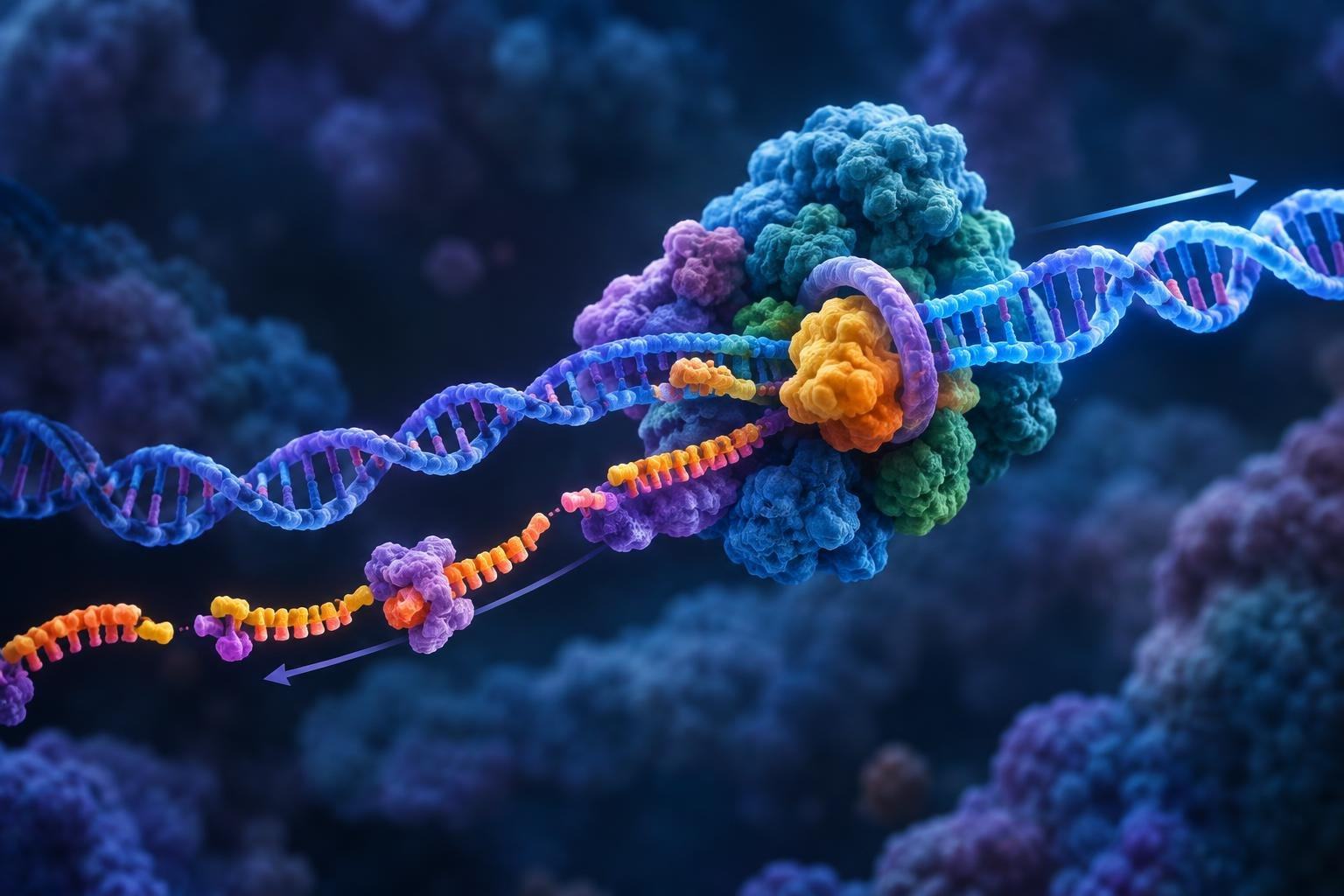
Copying a DNA molecule sounds like a straightforward task: unzip the double helix and use each half as a template for a new partner. But the two halves do not offer identical instructions for the copying machinery. One can be copied continuously; the other must be assembled in short stretches and stitched together later.
A study by researchers at King Abdullah University of Science and Technology (KAUST), published in Nature Communications, has recreated the human DNA-copying machinery in the laboratory. The researchers found that it can coordinate the two strands by briefly slowing work on one side while a new piece is started on the other.
One copying job, two different rhythms
Before a cell divides, it must duplicate its DNA so that each new cell receives a full set of genetic instructions. This essential task is carried out by a molecular assembly called the replisome, made up of nearly 50 proteins working together to open DNA and build new strands.
As the double helix opens, its two original strands point in opposite directions. The leading strand can be built continuously as the copying machinery advances. The lagging strand, by contrast, is made in short sections called Okazaki fragments. Those sections need further processing and must be joined to create a continuous strand.
That arrangement raises a coordination puzzle: how can both strands be copied at similar overall rates if one is produced in a steady run and the other in separate bursts? It is a little like keeping two work lines aligned when one makes a single long piece and the other produces many small ones that need assembly.
A brief pause helps the strands keep pace
To investigate, the KAUST team reconstituted a complete human replisome from purified proteins. In a controlled laboratory setting, the system copied both strands and allowed the researchers to examine the processing of lagging-strand fragments alongside synthesis. The researchers describe it as the first complete human replisome reconstituted in this way.
The team found that when the machinery begins a new lagging-strand fragment, it briefly slows DNA synthesis on the leading strand. That small adjustment helps coordinate activities that would otherwise proceed in different patterns. The enzyme that extends lagging-strand fragments is also efficiently reused, supporting the production of further pieces.
The pause is not a failure or a stop signal. It is part of the timing: a momentary adjustment that helps the two sides advance at similar overall rates. Meanwhile, the fragments do not all have to be fully processed and joined before the copying machinery moves on. Their maturation takes place behind it and can continue even after DNA synthesis has finished.
From a rebuilt machine to questions about disease
Recreating the process outside a cell gives researchers a way to study the machinery’s parts under controlled conditions. They can investigate how changes to individual replication proteins affect DNA copying—questions that are difficult to isolate when many processes are happening inside a living cell.
The KAUST team says it plans to use the system to study mutations associated with inherited disorders caused by changes in a single gene in Saudi Arabia. The aim is to understand how such mutations might disrupt replication and contribute to disease. That is a research direction, not a claim that the new system already diagnoses or treats these conditions.
The model also offers a starting point for exploring how DNA replication interacts with other processes in cells and how errors in the copying machinery arise. For now, its clearest lesson is about coordination: faithful copying does not require every component to work at the same speed. Sometimes the way to keep a complex machine on track is for one part to pause while another catches up.