
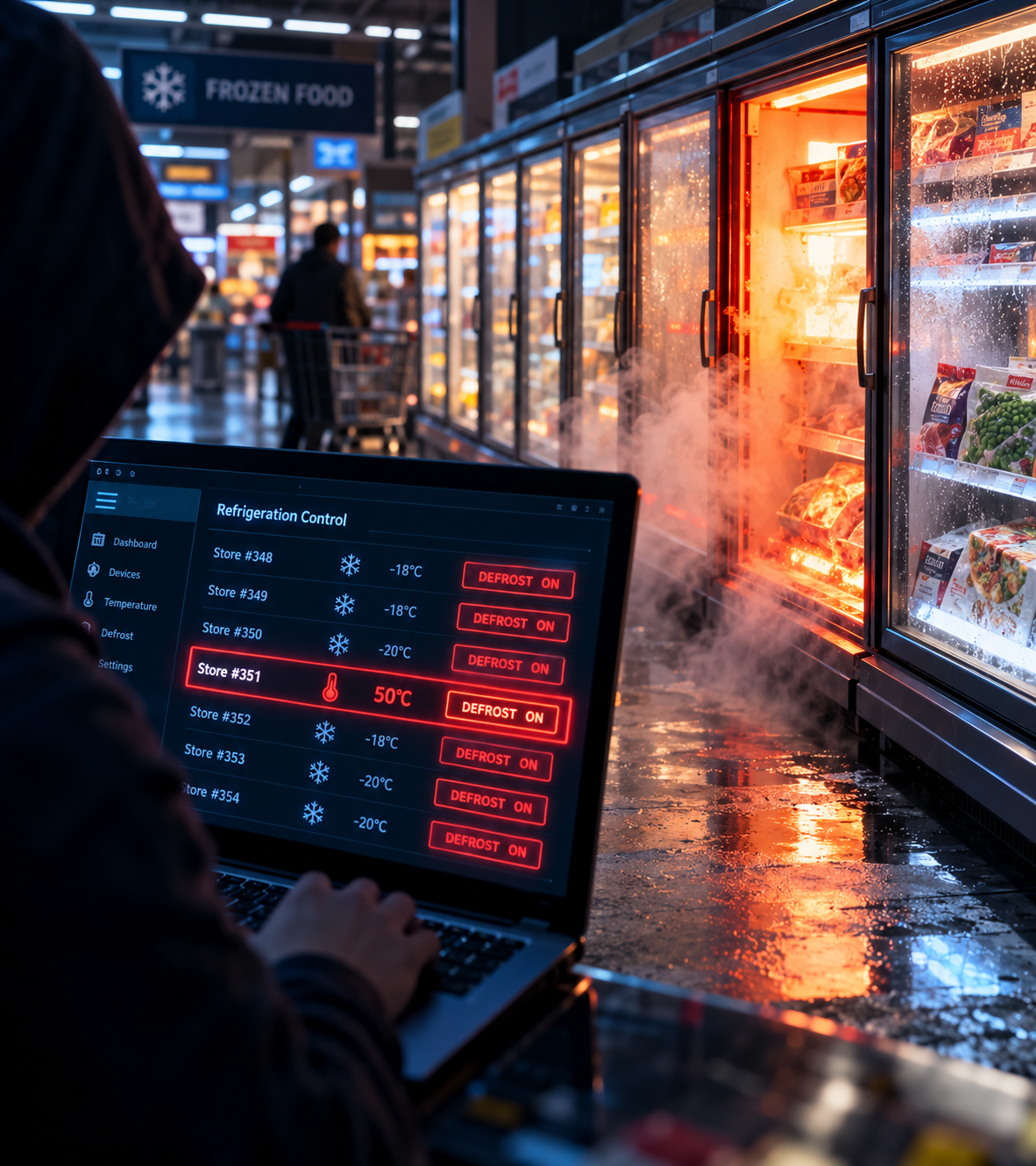
In the early hours of October 12, refrigeration in roughly 700 French supermarkets began doing the opposite of its job. Hackers took control of internet-connected controllers and switched units into defrost mode. Temperatures inside some climbed as high as 50°C (122°F); in some cases, refrigerators reportedly caught fire. By morning, workers faced spoiled food and stores faced potentially enormous losses.
The episode was not an attack on tills or customer accounts. It struck equipment that is easy to overlook because it works in the background: the controllers that monitor and manage commercial fridges and freezers. Their job is to keep temperatures within safe limits and let technicians check equipment remotely. In the affected systems, that remote access also opened a route for intruders.
The quiet machinery behind a supermarket
Security experts identified serious vulnerabilities in controllers associated with Danfoss, Dixell and Copeland. The devices were reachable over the public internet without a virtual private network, or VPN, to shield remote access. The flaws could give an intruder extensive system privileges. Copeland said the affected devices in its case belonged to a discontinued generation that had reached the end of its service life.
The account of the attack does not establish who carried it out or exactly how each system was accessed. But the basic weakness is clear: equipment designed for remote management had been left exposed. A supermarket can protect its office computers and still have a vulnerable entry point in a freezer controller, building-management system or other connected device.
Defrosting itself is not unusual. Frost builds up on cooling equipment and can interfere with its operation, so commercial systems periodically remove it. The problem was that an essential maintenance process was turned on at the wrong time and, apparently, at a scale the stores could not contain. Instead of preserving food, the equipment became a source of heat.
Why connect a fridge to the internet?
Remote monitoring can save technicians trips to stores and help operators spot faults or adjust cooling. It also offers a more ambitious possibility: treating refrigerated food and display cases as a kind of thermal battery.
A packed freezer does not warm instantly when its compressor pauses. The frozen goods and the equipment itself hold cold, giving the system some flexibility. In principle, a store can cool aggressively when electricity is plentiful or inexpensive, then briefly reduce power during periods of high demand. The food remains cold while the grid gets a little breathing room.
A 2018 pilot in northern Finland explored this approach, testing whether supermarket refrigeration could be switched off for up to 30 minutes without harming food or equipment. A separate UK project with Tesco examined coordinating defrost cycles with electricity availability. The scale can matter: Tesco has about 112,000 refrigeration systems under central software control, while refrigeration represents a substantial share of a grocery store’s energy bill.
There are limits. A system that has just completed defrosting may take longer to return to its target temperature if power is cut. And switching many compressors back on together could create a sudden surge in demand. Making refrigeration flexible therefore requires careful timing, monitoring and safeguards—not simply turning everything off when electricity prices rise.
Efficiency has a climate cost, too
Cooling groceries consumes a lot of power. A 2015 U.S. Environmental Protection Agency analysis estimated that refrigeration accounted for 40 to 60 percent of energy use in a typical supermarket. Refrigerants can add to the climate burden: hydrofluorocarbons, or HFCs, are potent greenhouse gases if they leak.
That is why retailers are also investing in more efficient equipment and refrigerants with lower climate impact. A 2025 Environmental Investigation Agency report said Carrefour spent nearly $90 million on low-global-warming-potential refrigeration technology in 2022, an investment it estimated was returning about $30 million annually while avoiding roughly 67,000 tonnes of carbon dioxide emissions each year.
Connected refrigeration could help stores cut bills, reduce emissions and support a grid increasingly supplied by variable renewable energy. The French attack shows the trade-off: the same connectivity that makes a freezer useful to a technician—or potentially to the power grid—can make it a target. Before supermarkets can rely on cold cases as flexible energy assets, they need to make sure only authorized people can control the temperature.