
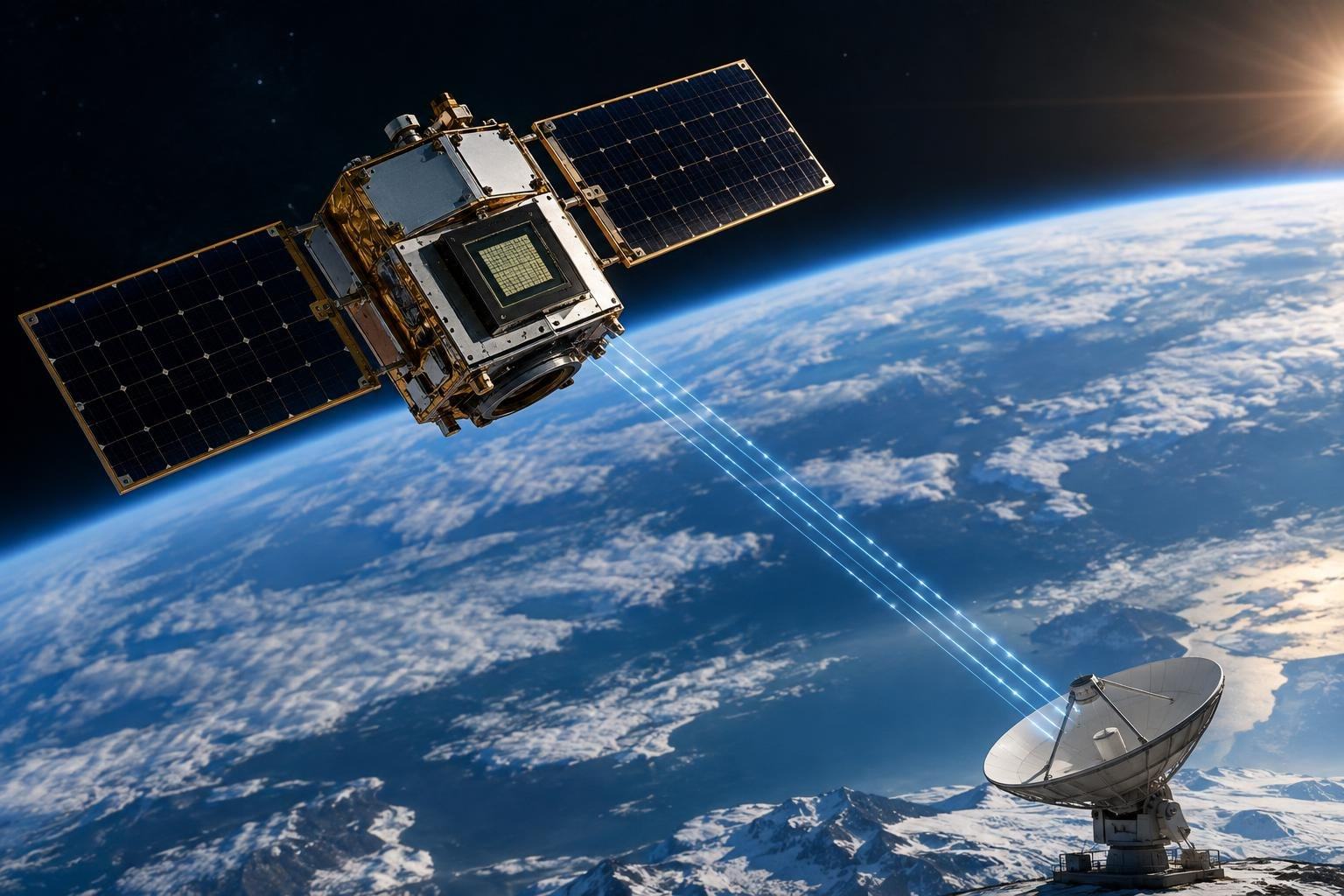
A satellite has sent a poem home from orbit. Google says its Project Suncatcher prototype has produced its first AI response: a haiku generated aboard the spacecraft and received on Earth after a prompt was sent up during a ground-station pass.
The verse was about the place its silicon now occupies: “Blue marble below / Data streams in silent grace / Starlight feeds my core.” It is a small, charming output—but the important part is not the poetry. It is that an onboard processor ran an AI model in space and returned the result.
A familiar AI task, in an unfamiliar place
Google launched the prototype on October 1. After several weeks of commissioning—checking the host spacecraft and its TPU trays—the team ran early machine-learning tests. For the first demonstration, it sent a prompt to the onboard Gemma 4 open model, which generated the haiku. The satellite’s response was downlinked as it passed Svalbard, Norway.
That sequence makes the test more meaningful than a chip simply switching on. The prompt had to reach the satellite, the processor had to execute the model, and the result had to make its way back to the ground. Google describes this as the first AI response from a data-center-class TPU in orbit. It is an early demonstration, not evidence that a full data center is ready to operate above Earth.
After the haiku, the team tried other space-themed writing prompts and asked the system to report telemetry—information about the technical status of the payload. Those tests begin to show how an orbital computer might handle both a simple creative request and practical monitoring tasks.
Why test computing hardware in orbit?
Project Suncatcher is a long-term research effort to explore powering AI computing in space. The idea raises an enticing engineering question: could some computing eventually be done beyond the planet, rather than relying entirely on facilities on the ground? But moving processors into orbit does not make the hard parts disappear. It changes what engineers have to solve.
On Earth, computers operate in environments where temperature, power and maintenance can be managed comparatively easily. In orbit, equipment must contend with changing thermal conditions and radiation exposure, while relying on systems that are difficult to repair. Communication also depends on a working link between spacecraft and ground stations. A successful prompt-and-response test is a first check of that chain, not a verdict on whether space-based computing will be practical or economical.
That is why Google’s next stated tests matter more than another clever poem. The company says it will assess how the TPUs perform under thermal stress and radiation exposure in orbit. Such trials can help establish whether the chips remain reliable in conditions unlike those of a conventional data center. The source material does not yet report results from those tests.
From one satellite to a connected pair
Google’s next planned milestone is to test two interconnected satellites in 2027. That would move the project beyond a single spacecraft handling an individual prompt and toward examining how orbital systems might work together. It remains a research step, not a promise of a commercial service or a vast network of computing satellites.
The distinction matters. A haiku is easy to understand, but it cannot answer questions about long-term reliability, the cost of launching and maintaining equipment, or how much useful work a satellite could perform. Those questions require sustained testing. For now, the achievement is narrower—and still striking: an AI model running on a TPU in orbit produced an answer that made it back to Earth.
The poem’s final line credits starlight for feeding its core. Whether space can become a practical place to do more computing will depend on a less poetic set of measurements: how well the hardware handles heat, radiation and the demands of staying connected. The first reply is in. The real conversation between engineers and orbit is only beginning.