
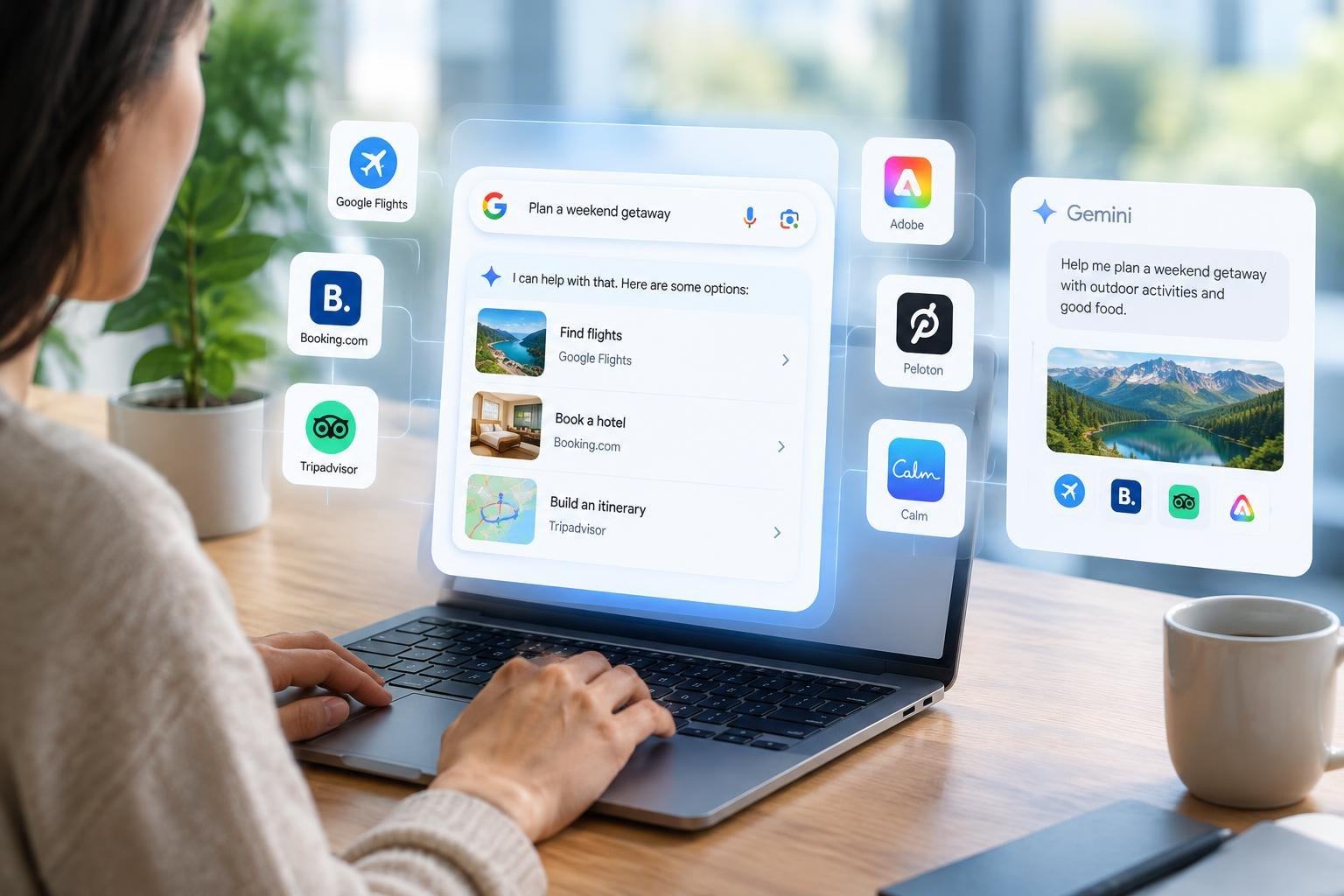
What if asking a question in Search could lead straight to the tool that helps answer it—or act on it? Google is building toward that idea with a preview of its Connected Apps Platform, a system for bringing more developers’ services into both Search and the Gemini app.
The ambition is bigger than adding another row of app icons. Instead of switching between services to complete a task, people may be able to reach an app’s capabilities from the place where they began looking for help. Google says existing Connected Apps already support activities such as ordering groceries and making playlists.
One integration, two Google destinations
For developers, the platform is designed to make distribution less fragmented. They can build an integration intended to reach users across Search and Gemini, then register, test and submit it through Google’s Connected Console. Before review, developers choose whether their app will appear in Search, Gemini or both.
The technical routes include a cloud-hosted MCP server or Android MCP using the AppFunctions APIs. In broad terms, MCP provides a structured way for software systems to expose capabilities to other applications. That matters because an AI assistant or search product needs more than a description of an app: it needs a defined way to interact with the service.
The console also gives developers a place to monitor traffic, latency and errors after an integration goes live. They can maintain elements of their identity, including verified logos and authenticated accounts. These details may sound administrative, but they help address a practical challenge: when an app appears inside a larger product, users and developers still need to know which service they are dealing with.
From finding information to reaching a service
Google says it has launched more than 50 Connected Apps across Search and Gemini, spanning areas including productivity, event ticketing, health and fitness. Integrations with Adobe, Experian, Localiza and Peloton are live in Gemini. Google says they are expected to arrive in Search in the coming weeks, while a new Calm integration is planned for both products.
That mix hints at how broad the idea could become. A creative tool, a fitness service or an event-ticketing app does not have to be a separate destination in every interaction; it could become an option surfaced at the moment a user is looking for something relevant. The usefulness will depend on the quality of those connections—and on whether they make tasks genuinely easier, rather than merely placing more services in front of people.
There is also an important distinction between finding an app and using it. A search result can point to a service; an integrated app needs a reliable way to carry out a task. Google’s platform is an effort to make those connections easier for developers to build and manage, while giving Google a common framework for bringing them into more than one product.
The convenience question
For users, a more connected assistant could reduce the friction of moving between apps. But convenience is only part of the test. As services become reachable through a search box or conversational interface, people will also need clear signals about which app is involved and what happens when they choose to use it. Google’s mention of authenticated accounts addresses one piece of that picture; the source does not detail how every integration will handle permissions or data.
Access to the platform is opening in phases, with more developers, markets and Google products to be added over time. That makes the preview a beginning, not proof that every app or task will soon be available in either product.
The larger shift is easy to miss: the app may remain where the work happens, while the search box becomes the place people decide what to do next. If Google’s connections work smoothly, the distance between asking for help and reaching the right tool could shrink to a single step.