
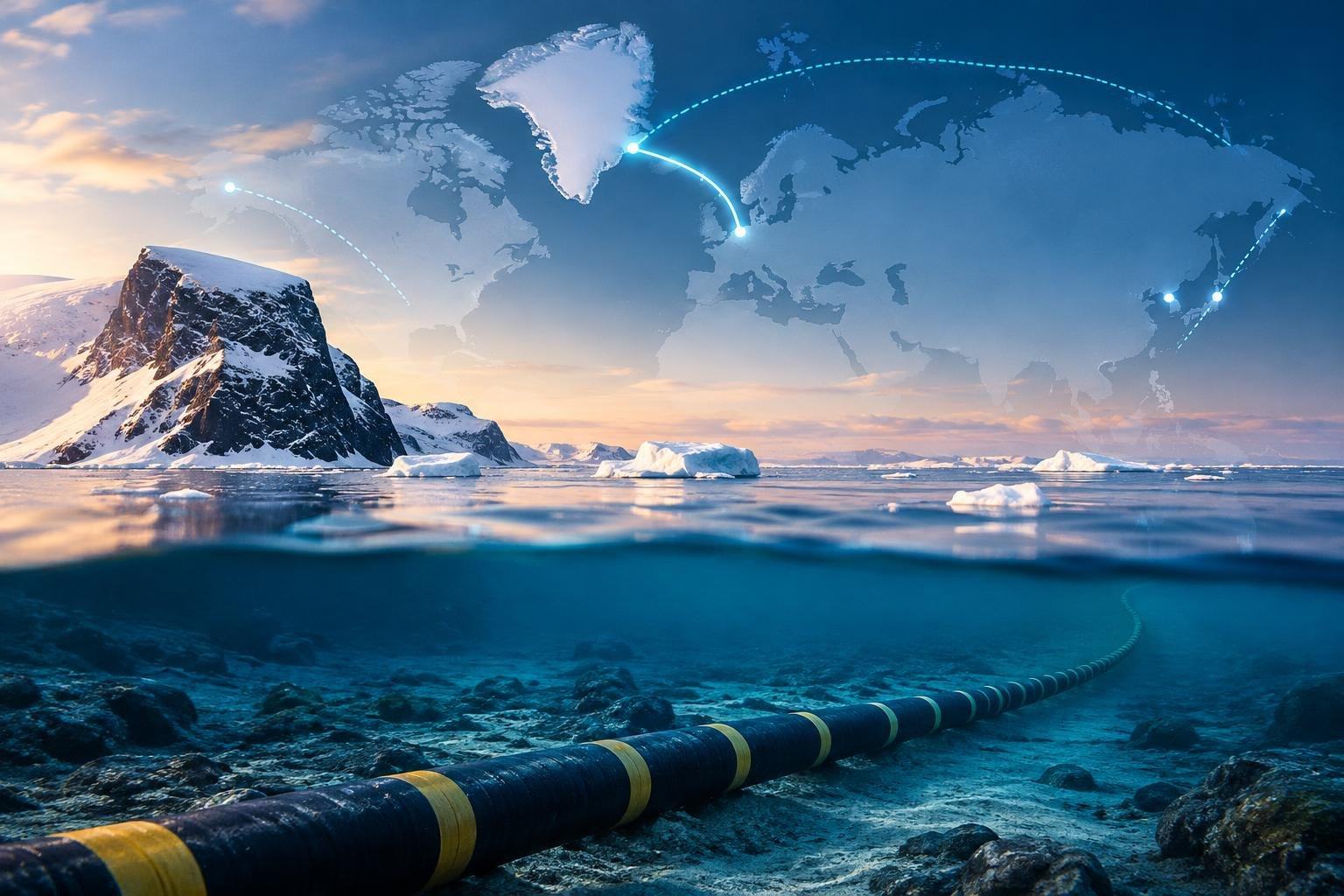
The internet can feel weightless: messages cross continents in a blink, and data seems to live somewhere in the cloud. In reality, much of the world’s online traffic depends on glass fibres laid across the seabed. Where those cables run can matter as much as how fast they carry information.
The European Union is backing a plan for the first subsea internet cable directly linking Europe and Greenland. Called the Pan-Arctic Cable, it could later be extended through Canada and, in time, toward Japan and South Korea—creating a possible Europe-to-Asia route that bypasses the United States.
A new line across the Arctic
The proposal appears in a European Commission joint communication published on October 20, 2026. The document describes the cable as a flagship EU project and calls for a “sovereign, secure and resilient” connection between Greenland and the EU. It also points to Canada as a potential partner for a future extension toward Asia.
That wording reflects the project’s appeal: not simply a new path for data, but a path Europe would have more control over. Undersea cables are physical infrastructure, vulnerable to accidental damage and disruption as well as political pressure. A second route cannot make those risks disappear, but it can give traffic another way to travel if an important link is interrupted.
Think of the global network less as one seamless cloud and more as a set of bridges between digital regions. A cable adds another bridge. Its value may be modest on an ordinary day, but much greater when another route becomes unavailable or less dependable.
Why look north—and look beyond the US?
Arctic geography offers a striking possibility: a connection running from Europe to Greenland, with Canada potentially serving as a step toward the Pacific. The eventual links to Japan and South Korea are possibilities, not confirmed parts of a completed route. The EU’s announcement establishes political support for the idea; it does not mean the cable has been built or that its final path and timing are settled.
Elisabeth Braw, a senior fellow at the Atlantic Council who leads its Threats to the Global Maritime Order Initiative, told Ars that considering the project would have seemed commercially unlikely five years ago. She called its emergence a sign of the times. In other words, infrastructure that once had to justify itself mainly as a business proposition is increasingly being discussed in terms of security and resilience, too.
The geopolitical backdrop is unusually pointed. In September 2026, a security agreement between the United States, Greenland and Denmark preserved Greenland’s autonomous status within the Kingdom of Denmark while expanding US military access. The agreement followed repeated attempts by the Trump administration to claim Greenland. Meanwhile, trade disputes and disagreements over Russia’s war in Ukraine have strained relations between Washington and allies in Europe and Canada.
A route that avoids the United States would not, by itself, prove that Europe intends to cut American networks out of global communications. It would, however, offer another option—and options become more valuable when governments no longer assume that political relationships will remain steady.
Routes matter as much as cables
The Arctic proposal also sits alongside Europe’s interest in new links to Asia. More than 90 percent of communications between Europe and Asia travel through undersea cables in the Red Sea, according to TeleGeography. That concentration makes the route a potential point of vulnerability, particularly as conflict has resumed between Yemen’s government and the Houthi faction. Houthi forces have fired missiles and drones at commercial ships in the Bab al-Mandeb Strait and the wider Red Sea.
That is the larger lesson hidden beneath the ocean. The internet’s resilience depends not only on the capacity of its cables, but on whether it has enough different paths—and whether those paths can remain available when shipping lanes, politics or security conditions change.
The Pan-Arctic Cable remains a plan, with a possible future stretching from Europe through Greenland and Canada toward Asia. But even before a fibre is laid, the proposal makes one fact visible: the supposedly borderless internet has a geography. Its future may depend on drawing more than one line across the map.