
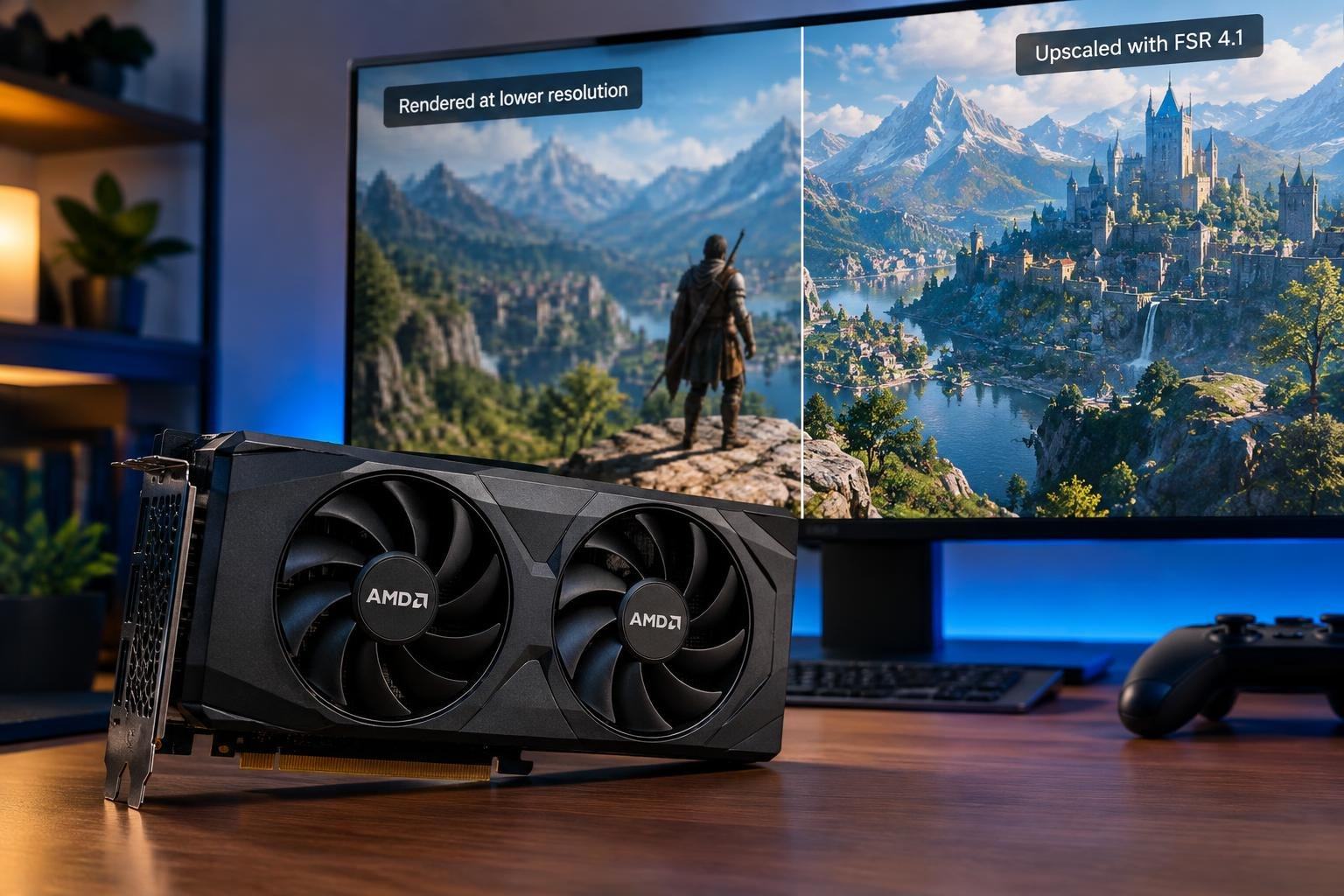
What if a graphics card could make a game look sharper without drawing every pixel the hard way? That is the promise behind upscaling—and AMD is now bringing its latest version to hardware that was not expected to get it so soon.
AMD has added FSR 4.1 support to Radeon RX 6000-series graphics cards, moving the planned arrival for those GPUs forward from 2027. The company also says the technology is coming to selected Ryzen processors, handhelds, Xbox products and, eventually, games using the Vulkan graphics interface. The broader story is not just a new software release. It is a test of how much extra life software can wring from hardware already in people’s hands.
The clever shortcut behind sharper games
Modern games create enormous images, calculating how light, surfaces and movement should appear across millions of pixels. Upscaling changes that workload: a game renders a smaller image, then software reconstructs a higher-resolution version. Done well, the result can look close to a full-resolution image while requiring less rendering work.
That saved effort can be spent on smoother performance or demanding visual effects. The reconstruction itself is a difficult guessing game: the system must decide what details belong in the larger image, using information from the current frame and, in temporal techniques, clues from earlier ones. Poor guesses can produce blur or flicker; better ones can preserve fine edges and motion.
AMD’s FidelityFX Super Resolution, or FSR, is its answer to Nvidia’s DLSS upscaling technology. FSR 4 is the latest generation described in the announcement, and version 4.1 is now reaching RX 6000 cards—an older generation than the RX 7000 series that already had support. The announcement signals expanded compatibility, but it does not provide performance tests or promise the same results on every supported device.
One technology, many kinds of hardware
The expansion reaches beyond desktop graphics cards. AMD says FSR 4.1 is planned for Gorgon Halo and Strix Halo chips used in mini desktops and mobile workstations, Gorgon and Strix Halo Ryzen 9 laptop processors, and Z2 Extreme and Z2A handheld chips. Xbox support is also on the way, with optimization planned for Asus ROG Xbox handhelds.
That variety matters because gaming increasingly happens away from a conventional desktop PC. A handheld has a compact screen and limited power and cooling compared with a large gaming computer. Techniques that reduce the rendering burden can help make demanding games more practical on smaller devices—though the announcement does not specify when each product will receive support or what gains players should expect.
There is another compatibility hurdle: the software interface a game uses to communicate with graphics hardware. AMD says FSR 4 is coming to Vulkan, a graphics API used by Linux systems, including the Steam Deck. Support there could make the technology available to more games and devices outside the Windows-and-DirectX ecosystem. The company has not given a release timetable.
When an upgrade arrives as software
Graphics hardware is usually discussed in generations: newer chips promise more speed, while older ones are treated as yesterday’s tools. But upscaling complicates that story. If software can reconstruct a convincing high-resolution image from less demanding work, some of a game’s visual progress may come from smarter algorithms rather than simply adding more silicon.
That does not make hardware limits disappear. Compatibility is not the same as identical performance, and the benefits will depend on the game and device. Still, bringing FSR 4.1 to RX 6000 cards earlier than planned gives owners of those GPUs a reason to watch the software side of gaming as closely as the next hardware launch.
AMD also says its FSR Redstone technology is now in more than 400 games on Radeon 9000-series graphics cards, and that its Ray Regeneration denoising technology is coming to more games. Those developments point to a wider shift: graphics features are increasingly delivered as a growing toolkit, not just as a perk attached to one new card.
The intriguing question is how far that shift can go. A graphics card cannot escape its physical limits—but perhaps the next leap in how games look will come not from replacing the chip, but from teaching it to spend its effort more wisely.