
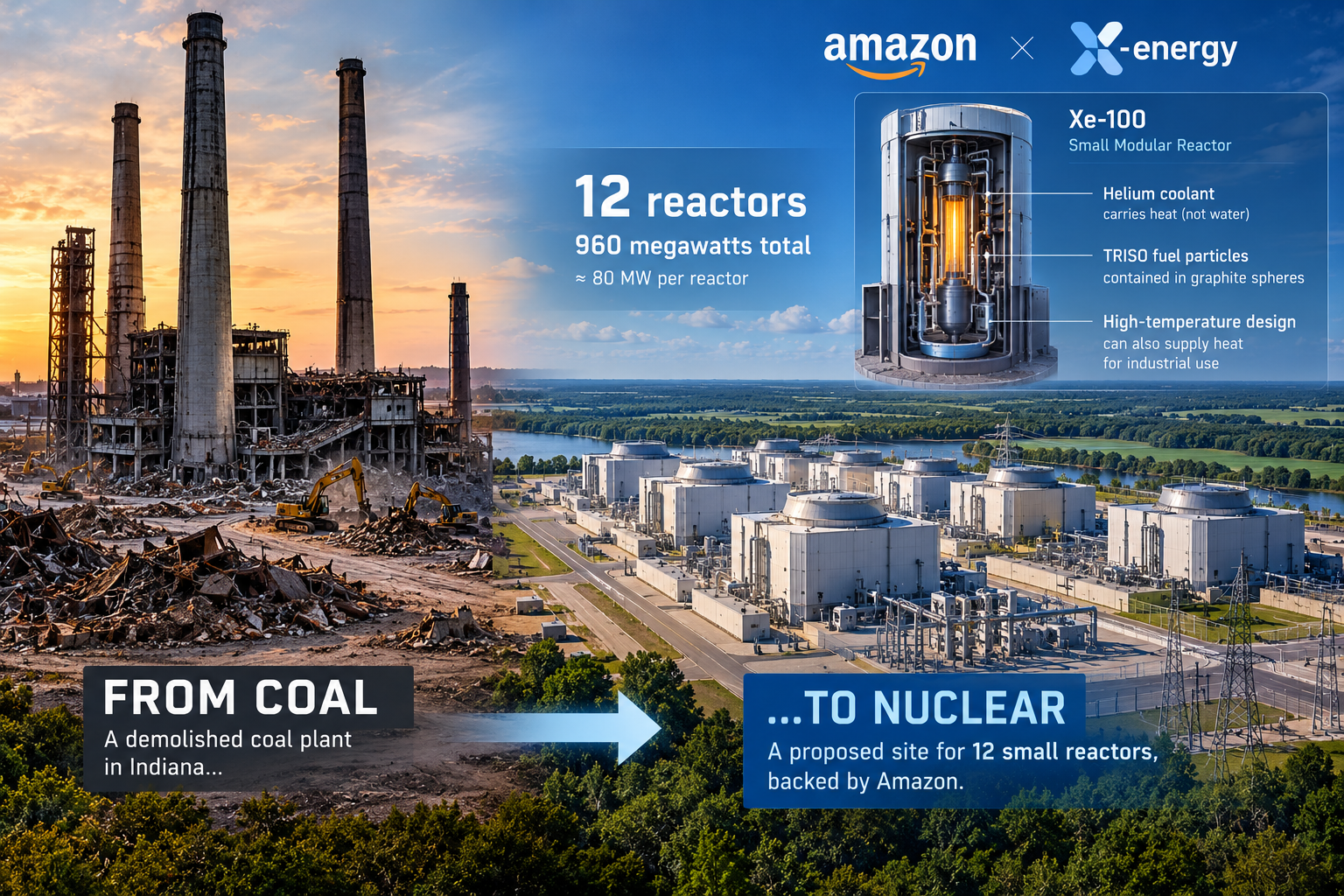
A power plant can outlive the fuel it was built to burn. Just south of Terre Haute, Indiana, a demolished coal station may become the site of a very different kind of facility: a proposed nuclear plant with 12 small reactors, backed by Amazon and designed to send electricity to the public grid.
The plan is striking not only for what would replace coal, but for the wager behind it. Can nuclear power become easier to build by making its reactors smaller—and repeating the same design many times?
Twelve reactors, one bigger test
Amazon is funding development of the proposed 960-megawatt plant and would be its first customer. American Electric Power would operate it, while X-energy would supply its Xe-100 reactors. Dividing the planned capacity among 12 units works out to 80 megawatts per reactor on average.
That is the logic of a small modular reactor, or SMR: instead of relying on a few enormous units built as one-off projects, developers hope to manufacture smaller, repeatable reactors and assemble them at a site. In principle, repetition could turn construction into something more like industrial production, where a standard design gets quicker and less costly as experience accumulates.
The Xe-100 is a high-temperature, gas-cooled design. It uses helium to carry heat from the reactor, rather than water as in many conventional nuclear plants. Its fuel is held in small, coated particles embedded in graphite spheres, a design intended to retain radioactive material at high temperatures. The broader attraction of high-temperature reactors is that their heat could serve industrial processes as well as generate electricity.
But a modular design is not a magic shortcut. Factories, suppliers, regulators and construction crews all have to learn how to deliver the same equipment reliably. Industry experience suggests that the benefits of mass production can take years to emerge—potentially about a decade—so the first projects may not enjoy the efficiencies promised for later ones.
A data-center customer, but not a private power island
Amazon says the Indiana plant’s electricity would also serve its data centers. Yet the reactors would connect to the public grid, rather than supplying only a dedicated campus. That distinction matters: the proposal links the electricity needs of cloud computing to a plant intended to operate as part of the wider power system.
Data centers need large, steady supplies of electricity, and the expansion of computing has sharpened questions about where that power will come from. Nuclear plants can produce electricity without burning fossil fuels during operation, but a proposed plant is not the same as available power. The Indiana project still needs to be built, and its timetable depends in part on whether X-energy can deliver its first plant.
That first project is planned for a Dow Chemical site in Seadrift, southeast of Houston, where four Xe-100 reactors are meant to provide heat and electricity. X-energy says its construction permit is in the final stages of review by the U.S. Nuclear Regulatory Commission, but construction has not begun. The site is also facing a lawsuit from Texas, which alleges repeated violations of water and solid-waste rules and permits.
The promise—and the unproven part
For Amazon and X-energy, the Indiana agreement is their second commercial deal and three times larger than their first, announced two years ago. The companies have said they aim to develop 5 gigawatts of new U.S. nuclear capacity by 2039. That ambition makes the Indiana plant more than a single project: it is a test of whether a reactor design can move from promise to repeatable construction.
The need for a different approach is real. Recent U.S. nuclear projects have suffered major cost overruns and delays, helping make new plants difficult to finance. SMR developers argue that smaller units and standardized manufacturing can reduce those risks. Yet the first unit still has to be designed, licensed, built and operated successfully before repetition can do much of the work.
That is the central tension in Indiana’s proposal. A coal plant’s footprint may be reused, and a dozen smaller reactors may look more manageable than one giant project. But the decisive change would not be the scale of any single reactor. It would be proving that the same one can be built again—and again—without every new copy becoming another first-of-a-kind gamble.