
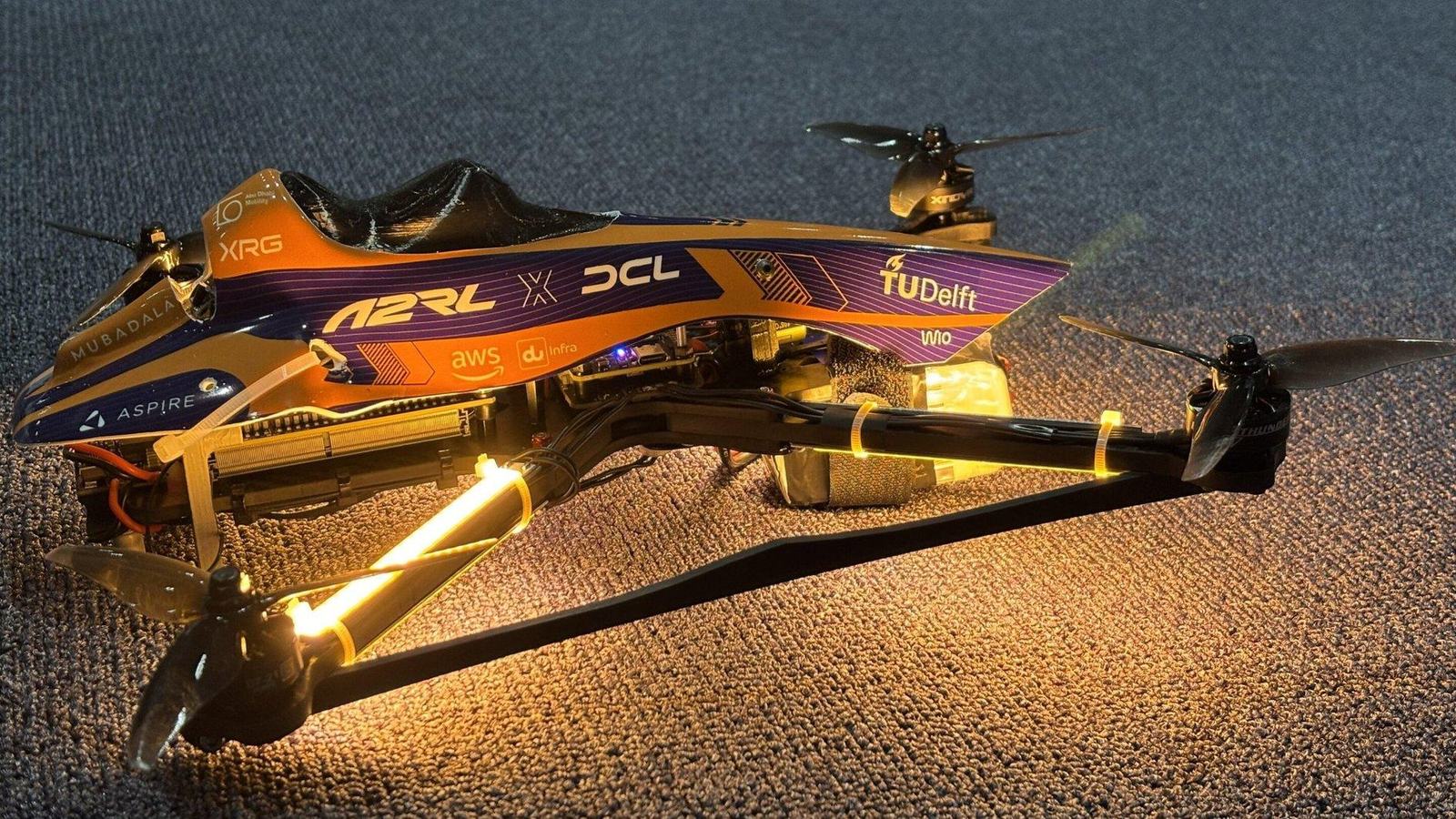
An AI-controlled quadcopter has flown a championship drone-racing course faster than three former human world champions, using a compact onboard system built around a single camera and an inertial measurement unit. The system, called MonoRace, won the 2025 Abu Dhabi Autonomous Racing League drone-racing competition, beating the other autonomous teams. In the race, it completed two laps around 11 gates in 16.56 seconds and reached a top speed of approximately 63 mph (102 km/h), according to a study published Oct. 14 in Science Robotics. The researchers, from Delft University of Technology’s Micro Air Vehicles Lab in the Netherlands, designed MonoRace to fly without GPS, stereo cameras, external motion-capture equipment or a preloaded map of the course. Its name refers to its monocular vision: the drone uses one forward-facing rolling-shutter camera. An onboard inertial measurement unit tracks acceleration and rotation. Information from the sensors is used to identify gates and estimate the drone’s position and movement. A neural network then translates that estimated state into motor commands. The commands reach the four propellers through the flight controller 500 times per second. The complete system operates aboard a drone weighing 966 grams (2.13 pounds) and measuring about 30 by 28 by 10 centimeters (11.8 by 11 by 3.9 inches). Its compact, lightweight hardware and efficient computing allowed the researchers to avoid relying on a computer off the aircraft during flight. Learning through simulated flights MonoRace’s control model was trained using reinforcement learning, a method in which a system tries a task repeatedly and receives feedback on its performance. The training took place in simulation, where the model could make the millions of attempts the researchers said were needed to learn to fly from scratch. Training began with basic goals, such as avoiding crashes and reaching the first gate. The system then learned to progress farther through the course and increase its speed. Researchers also varied simulated aircraft characteristics, including weight, voltage, drag, sensor noise and propeller condition. The aim was to help the trained model handle differences and imperfections in real drones, rather than relying on one precisely configured aircraft. The study’s co-author, Delft professor Guido de Croon, explained that the training simulation did not reproduce camera images. Instead, the control network received an estimated state from a separate perception and state-estimation process. Some imagery in a video about the project is computer-generated, including a sequence illustrating training; the rest of the footage shows real flights, although some shots add graphics to explain what the drone detects. Those graphics show how a convolutional neural network segments the white racing gates in the camera view. Markers indicate detected gate corners and edges, while an overlay shows where the system expects to find the next gate. The results demonstrate a way to combine fast autonomous control with limited onboard sensing and computing. The control network runs on a microcontroller-class chip, rather than requiring a large computer. De Croon suggested the approach could also inspire human drone pilots, and that similarly sized networks might be trained to favor low energy use instead of the fastest lap time. That possibility could matter for other robots that operate with small processors, though the study’s demonstrated result is high-speed racing, not energy savings in everyday machines.
AI Racing Drone Beats Human Champions on a Championship Course
A lightweight drone trained in simulation flew two laps through 11 gates in 16.56 seconds, reaching about 63 mph without GPS or external tracking.
This image may have been generated, edited or modified using AI and may contain inaccuracies. © BadgerHunt. All rights reserved.
Source
Read source article