
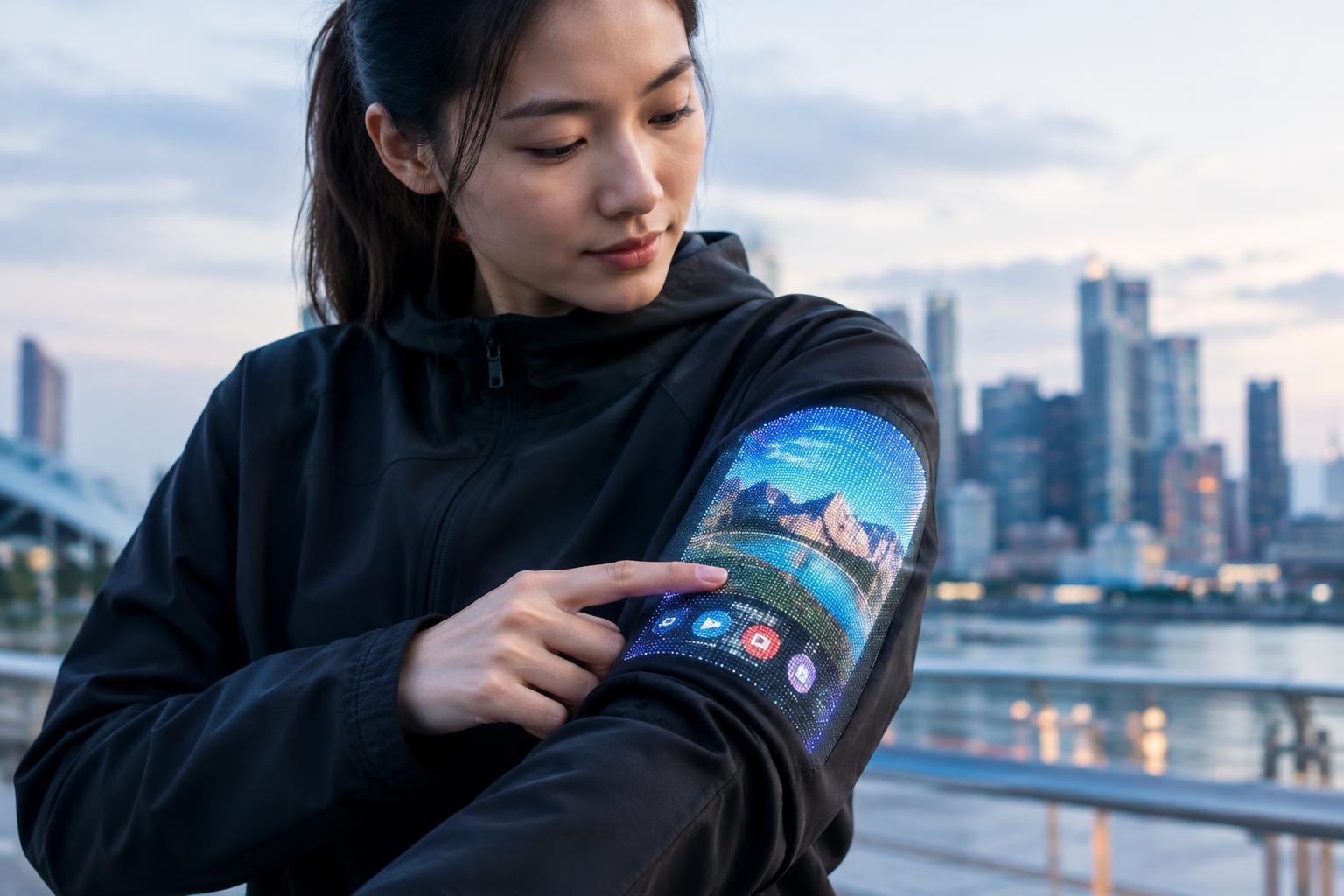
A screen is usually a slab: glass over electronics, held in the hand or fixed to a wall. But what if the pixels were not arranged on a panel at all? Researchers at the National University of Singapore have made a garment sleeve that displays images and video, responds to touch and connects wirelessly—while remaining fabric.
The intriguing shift is not simply that clothing can light up. It is that a thread can do the work of a tiny, flexible computer interface: showing information and sensing where a finger presses. The prototype suggests that a screen’s familiar flat shape may be a design choice, not a requirement.
How to build a circuit along a thread
Conventional displays rely on electronics patterned across a two-dimensional surface. A fibre, by contrast, is long and narrow, with circuitry wrapped around its length. Connecting thousands of components along it is a little like wiring a city along a road that has no side streets.
The NUS team tackled that problem by making precise connection points on insulated wires. A laser exposes each chosen spot; then carefully controlled wetting guides molten solder to bond there, rather than elsewhere. This approach let the researchers link more than 5,000 chips through over 20,000 electrical connections.
They then used a process called thermal drawing to form several functional layers inside a fibre roughly a millimetre thick and 10 metres long. Think of it as making a highly engineered strand in which light-producing elements and touch-sensing circuitry run together. Pressing the fibre completes a circuit; the resulting signal identifies the touch location and lights the nearest pixel.
A sleeve becomes a small, touchable display
For the demonstration, 54 pixel fibres were threaded into the forearm of a sleeve. Each fibre carries 96 LEDs, forming a display with 96 by 54 pixels, about 168 by 105 millimetres in size. It refreshes 30 times a second and supports 8-bit colour.
The sleeve can play video, show photographs, run a calculator and receive images over Bluetooth. Other fibres provide a microphone and speaker, as well as sensors for movement, temperature, light and magnetic direction. The wearer can interact with the display using several touches at once; if one fibre fails, its neighbours can continue working.
These features evoke the early capabilities of a smartphone, but the point is not to tuck a phone into a sleeve. The interface is part of the garment itself. A temperature-sensing fibre positioned under the arm, for example, can measure body temperature and show the result on the clothing.
Fabric has to survive being fabric
A wearable display would be a novelty if it demanded careful handling. The researchers report that light output and touch response were nearly unchanged after 50 detergent washes in a typical washing machine and 1,000 bends around a five-millimetre radius. The display is also reported to be as breathable as cotton, polyester and denim, and to remain within established skin-contact safety limits.
That combination matters because textiles are not just screens worn on the body: they stretch, fold, breathe and get washed. The team says its thinner fibres could be knitted, woven or embroidered using standard industrial machines, opening a route to larger or sharper displays without turning clothes into rigid gadgets.
From looking at data to feeling it
The more consequential possibility may be health monitoring. Clothing already sits close to the body; fibre-based sensors could gather physiological information, while a display built into the same garment could let someone check or interact with it. The researchers describe personalised monitoring and feedback, potentially assisted by AI, as a future direction—not a capability established by this prototype.
For now, this is a working demonstration, not a replacement for phone screens or a ready-made medical system. The team’s next goals include higher resolution, more integrated sensing and on-device AI. Yet the experiment poses a larger question: if pixels can be threaded into cloth, perhaps the next interface will not be another object we carry. It may be something we wear—and barely notice until it has something worth showing.