
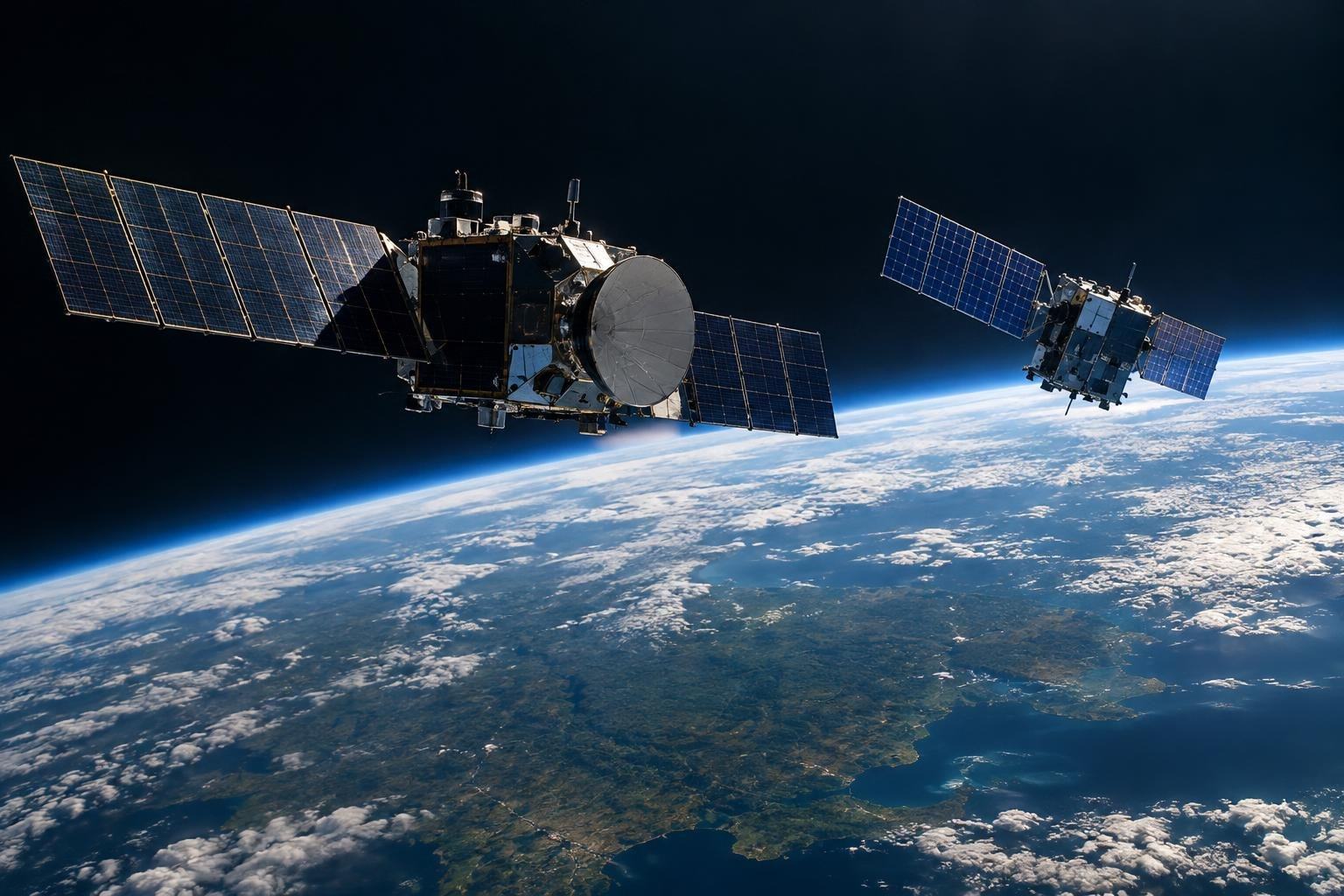
Space is so vast that a satellite passing within a few hundred metres of another sounds almost impossible. In low Earth orbit, though, that is not a reassuring cushion. A Russian military spacecraft, Cosmos 2612, manoeuvred close to ICEYE-X36, a US-registered commercial radar satellite whose company supplies imagery to militaries, including Ukraine’s partners. The episode turns a question of orbital distance into a question of wartime boundaries: when a private satellite helps a country at war, can it still be treated as civilian infrastructure?
How close is close in orbit?
Tracking reports describe Cosmos 2612 moving from more than 320 kilometres away to around 4.8 kilometres, then changing position relative to ICEYE-X36. LeoLabs, a space-tracking company, estimated the closest pass at about 500 metres. Other reports have suggested a distance below 30 metres, but estimates are uncertain; the exact separation has not been established.
Even the more cautious figure is striking. Satellites in low Earth orbit travel at roughly 7.5 kilometres per second. They do not behave like cars cruising steadily side by side: spacecraft can alter their paths, but their relative motion, position and timing must be calculated carefully. A close approach without the other operator’s cooperation is hazardous because a small error can become a collision. One space expert compared the manoeuvre to putting a car just centimetres from another vehicle on a motorway.
The sequence appears to have unfolded over months. Cosmos 2612 was one of six Russian military satellites launched in April. In May, four of them moved close to an ICEYE satellite. ICEYE’s chief executive later said the company moved its own spacecraft, after which Russian manoeuvres appeared to follow. A Ukrainian official confirmed that Ukraine’s military works with ICEYE, but said it was unclear whether this particular satellite supports Ukraine.
A radar satellite sees through the weather
ICEYE-X36 is not a conventional camera in orbit. It carries synthetic aperture radar, which sends out radio pulses and measures their return to build an image of the ground. Unlike optical imagery, radar can work at night and through clouds, making it useful when weather or darkness would frustrate an ordinary camera.
That capability helps explain why commercial spacecraft matter in modern conflict. A country does not need to own a satellite to benefit from the information it gathers. Commercial operators can sell imagery and services to governments, while the same infrastructure may also serve other customers. The result is a blurred line between civilian business and military utility—and, potentially, between what an adversary sees as a civilian asset and what it regards as part of a rival’s war effort.
Surveillance, intimidation—or a rehearsal?
There is no confirmed explanation for Cosmos 2612’s manoeuvre. Analysts have raised several possibilities: it might have been a test of how satellite operators respond, an attempt to intimidate Ukraine’s supporters, or a rehearsal for more dangerous activity. A close approach could, in principle, create opportunities for surveillance or interference, but the available information does not show that data were intercepted or service disrupted. A deliberate collision would be a far more extreme step.
Russia has previously brought spacecraft near Western satellites, including US spy and communications satellites. But analysts say this incident stands out because the target was commercial and the reported approach unusually close. That matters in a world where military communications and intelligence increasingly depend on services supplied by private companies. Russia has also warned at the United Nations that “quasi-civilian” infrastructure could be a legitimate target for retaliation.
There is a revealing contradiction here: commercial satellites can look less politically sensitive than government spacecraft, yet their usefulness to militaries may make them more exposed. ICEYE-X36 is owned by the US arm of a Finnish company and registered as a US satellite, adding another layer to the question of whose interests—and whose protection—are involved.
For now, the close pass is a warning, not proof of an attack. Its lasting significance may lie in the message that no spacecraft is entirely removed from conflict simply because it is privately owned or hundreds of kilometres above Earth. In orbit, the most consequential boundary may not be the distance between two satellites, but the increasingly difficult distance between civilian technology and military power.