
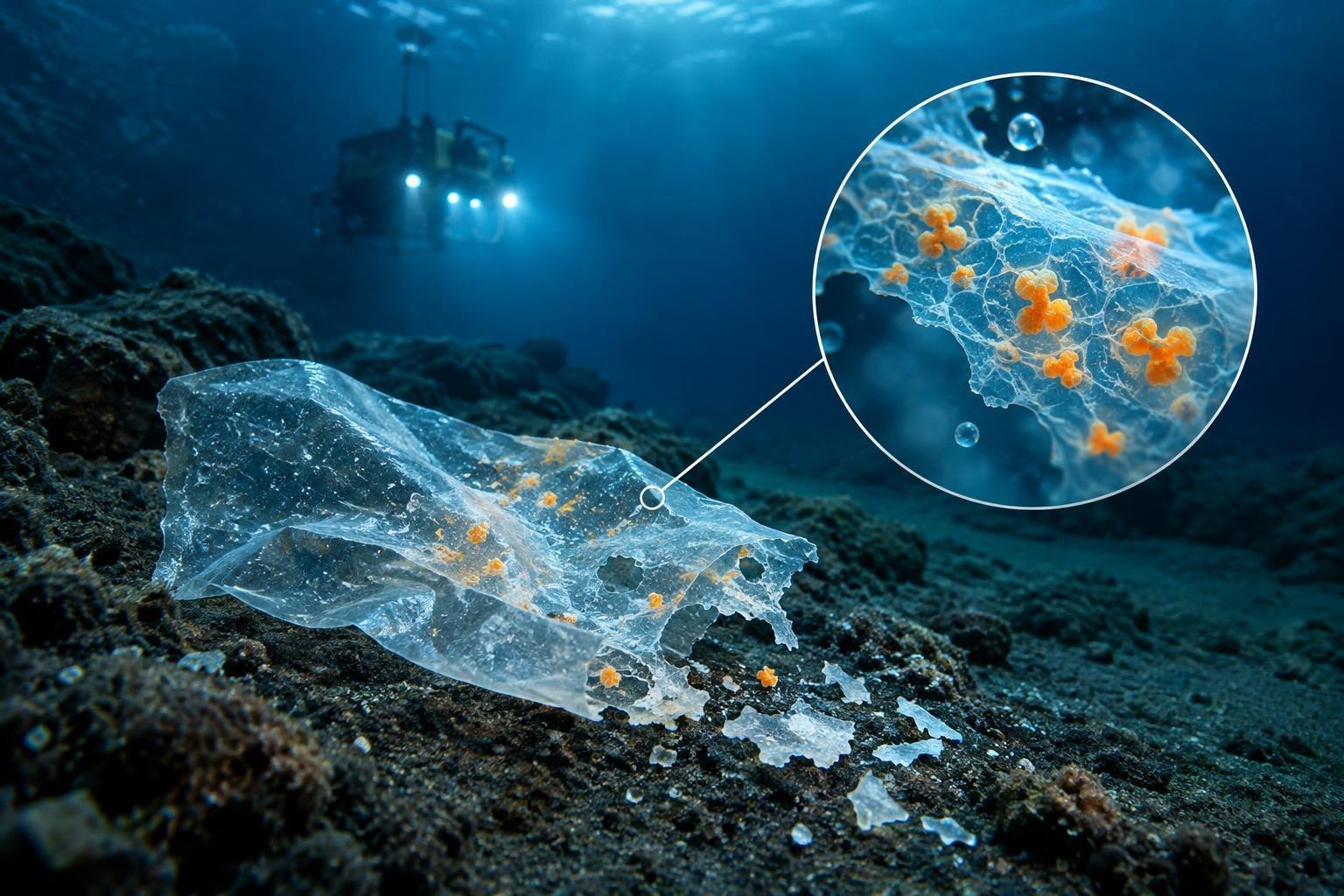
The deep ocean is an unlikely place to expect plastic to break down quickly. It is cold, under immense pressure and often short of the microbes that digest particular materials. But researchers in Japan have found a way to bring part of the cleanup machinery along: they mixed plastic-degrading enzymes into the plastic itself.
In tests reported in Nature on October 21, the enzyme-containing films degraded far faster than comparable films without enzymes. Some nearly vanished from a deep-sea site within five months. The approach also includes a proposed “start switch”: the embedded enzymes remain inactive without water, but can begin breaking down the plastic when damage or wear exposes them.
Giving plastic its own breakdown crew
The team made films and tiny beads from four biodegradable polyesters: PBS, PBSA, PCL and PBAT. During heat processing, they mixed in small amounts of cutinase or lipase, enzymes that can break chemical links in these plastics. Think of the enzymes as miniature cutting tools dispersed through the material, rather than organisms that must first arrive and multiply on its surface.
That distinction matters underwater. Biodegradable plastics rely on microbes and their enzymes to break apart, but the right microbes are not equally common everywhere. Earlier research had found that some biodegradable plastics can degrade on the deep-sea floor, while also revealing that the process may be slow and that local microbial communities do not necessarily contain organisms able to break down every type.
In the new study, researchers placed samples at four deep-sea locations, from 757 metres to 5,503 metres below the surface, and at a waterfront site in Japan. At the 757-metre site, water was about 4 degrees Celsius and pressure was roughly 75 times atmospheric pressure. After five months there, enzyme-loaded films made from PBS, PBSA and PCL had almost completely degraded. Without embedded enzymes, the greatest weight loss in the comparison films was only 3.4 percent.
A trigger, not a timer
The enzyme is not supposed to make a product fall apart on the shelf. According to the researchers, it has no degrading activity in dry conditions. Their proposed trigger is physical damage: if a product escapes into the environment and abrasion or impact breaks it into smaller pieces, water can reach the embedded enzyme and start the process.
This is a notable design idea because it aims to separate a material’s useful life from its fate after it becomes waste. In the researchers’ tests, the enzyme-containing plastics retained strength and flexibility comparable to the original materials. At the waterfront site, PBSA and PCL films with enzymes nearly completely degraded within a month.
The speed-up varied with the plastic and enzyme used. The research team reported rates five to 50 times higher at the waterfront and 12 to 80 times higher in deep-sea tests than for plastics without embedded enzymes. The study also tested small plastic beads, measuring 20 to 200 micrometres across; the researchers reported that the enzyme-containing beads degraded rapidly in the marine environments examined.
Promising results, with practical questions ahead
The findings do not mean that ordinary plastics such as polyethylene or polypropylene will break down this way. Those common materials were not the target: the method was tested on specific biodegradable polyesters. Nor does “biodegradable” mean that every product will disappear wherever it is discarded. Conditions, material composition and the surrounding environment all matter.
Before the technique can be used widely, the team says it needs to investigate long-term durability and safety in real use, apply the method to more materials, and make production more efficient and affordable. Those are substantial steps. A useful product must remain dependable during its intended life, and its breakdown products and environmental effects must be understood.
Still, the central insight is compelling: instead of relying entirely on nature to supply the right decomposers, a plastic could carry some of the chemistry needed to dismantle it. The deep ocean is no longer just a place where waste sinks out of sight. In these experiments, it became a demanding test of whether that chemistry can keep working when the cleanup crew is scarce.