
A glass of seawater is not an obvious fuel source. It is mostly water, but its dissolved salts complicate a process that sounds simple: use electricity to split water molecules and collect the hydrogen.
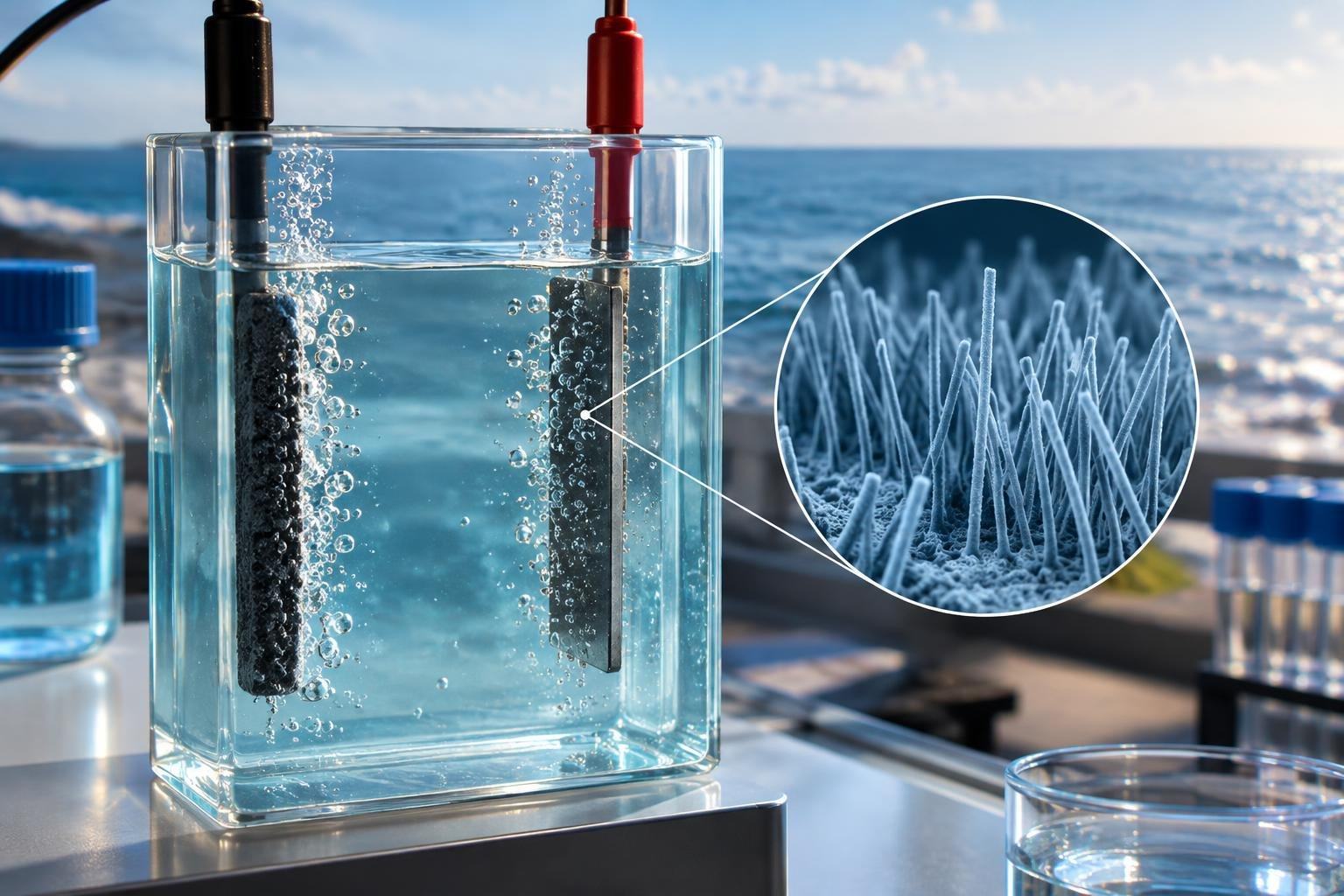
A newly reported laboratory test offers a small but intriguing step. Researchers used a nanowire electrode to produce hydrogen from neutral seawater—water that is not made strongly acidic or alkaline for the reaction. The result points to a possible way of simplifying one part of hydrogen production, though a lab demonstration is not yet a practical way to fuel ships or power industry.
Why salt makes water splitting harder
In conventional electrolysis, electricity drives two reactions. At one electrode, water produces hydrogen; at the other, oxygen is released. The equipment needs an electrolyte to help carry electrical charge, and many systems use strongly acidic or alkaline conditions to make the chemistry work efficiently.
Seawater brings its own electrolyte: dissolved ions, including chloride. But chloride is not just a helpful carrier of charge. Under some conditions it can take part in reactions that produce chlorine-containing compounds, while salt can also accelerate corrosion. A system that makes hydrogen but damages its components—or generates unwanted products along the way—would be of limited use.
“Neutral seawater” matters because it describes the conditions of the reported test, not a claim that every challenge of using seawater has been solved. The study’s headline result is hydrogen production in the lab; the information available here does not specify the device’s output, operating life, efficiency or how it performed at larger scale.
What nanowires may bring to an electrode
Nanowires are extremely slender structures, and arranging them on an electrode can create a large amount of surface area in a compact space. That can give reactions more places to occur. It is a broadly useful design idea in electrochemistry, although the fact that an electrode is made with nanowires does not, by itself, establish exactly why it performed as it did in this particular test.
The key question is not simply whether hydrogen appears. Engineers also need to know how much electricity the process consumes, how selectively it makes hydrogen rather than unwanted products, and whether the electrode keeps working in salty water over time. A brief or small-scale success can identify a promising route; it cannot answer all of those practical questions.
From a lab result to a useful fuel
Hydrogen can store energy and serve as a feedstock for industrial processes, but producing it is only one part of the equation. The electricity must come from somewhere, and the system must be durable and economical. If renewable electricity is used, electrolysis can potentially turn variable power from wind or solar into a fuel that can be stored and transported.
Using seawater could eventually be attractive in places where freshwater is scarce or where energy equipment operates near the coast. It might also avoid some of the infrastructure needed to supply purified water. Those are possible advantages, not demonstrated outcomes of this laboratory test: the study result alone does not show that seawater electrolysis is cheaper, cleaner or ready for coastal deployment.
For now, the nanowire electrode is best understood as a proof of possibility: hydrogen can be produced from neutral seawater under laboratory conditions. The next test is whether the chemistry can remain selective and the hardware can keep working as the salt, current and operating time add up.
Seawater is abundant, but abundance is not the same as accessibility. The interesting engineering challenge is turning the ocean’s water into a useful energy carrier without letting the ocean’s chemistry dictate the cost.