
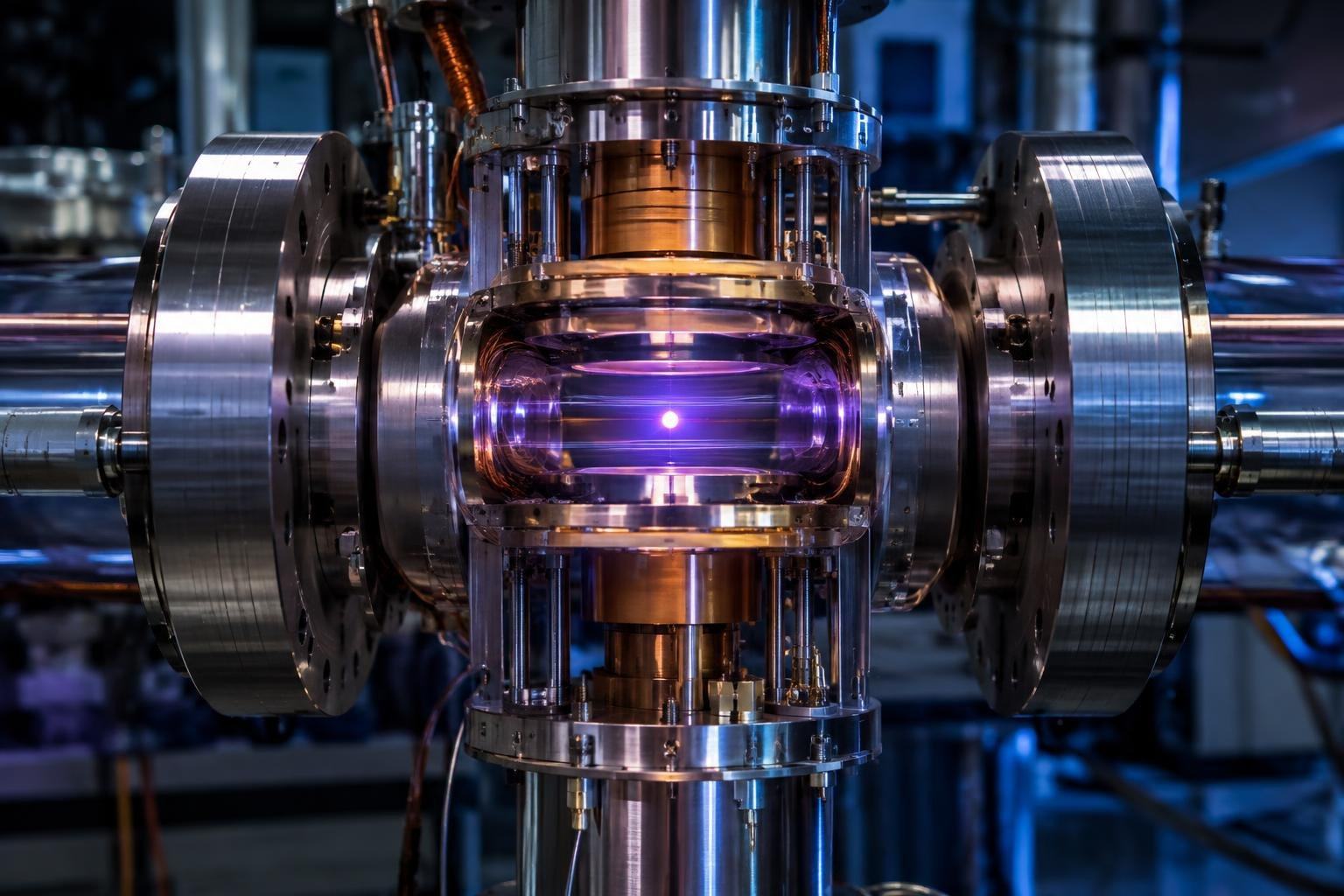
Why is the universe made mostly of matter? The question reaches from galaxies down to the tiniest particles, and one possible clue lies in a test so delicate it begins with a single antimatter particle held almost perfectly still.
Physicists led by Gerald Gabrielse at Northwestern University have trapped one positron—a particle with the same mass as an electron but the opposite electric charge—in a device they call a one-positron quantum cyclotron. For the first time, they have resolved the particle’s lowest-energy quantum states. The experiment is not yet a new answer to the matter–antimatter mystery. It is a new way to ask whether nature treats matter and antimatter as mirror counterparts with extraordinary precision.
Quantum steps in a magnetic cage
A Penning trap uses electric and magnetic fields to confine a charged particle. In the strong magnetic field, the positron moves in a circular path, rather like a bead circling inside an invisible bowl. But in the quantum world, that motion cannot take just any value: the possible orbits come in discrete energy levels.
The team cooled its apparatus to 300 millikelvin and captured fast positrons produced by the decay of a sodium nucleus. In that frigid setting, the particle can occupy its lowest-energy states and be observed making individual quantum jumps, rather than blurring across many levels. The researchers also drove it into higher states using electromagnetic energy, including transitions that flip its spin.
Think of the positron’s orbit as a tiny ladder, with its spin acting like a small compass needle. The energy required to move between spin orientations depends on the particle’s magnetic moment: the property that describes how strongly it behaves like a miniature magnet. Measure the energy difference, and physicists can infer the strength of that magnetic moment.
What a perfect twin would mean
The comparison rests on a foundational idea called CPT symmetry. It combines three imagined changes to the universe: swap every particle for its antiparticle, reflect everything in a mirror, and run time backward. The Standard Model predicts that the laws of physics would remain unchanged under all three transformations performed together.
One consequence is that an electron and a positron should match in mass, while their magnetic moments should have the same magnitude and opposite signs. The electron’s magnetic moment has already been measured to about one part in 10 trillion using a similar one-electron quantum cyclotron. Gabrielse’s team hopes to bring the positron measurement to comparable precision.
That result has not yet been achieved. The new experiment establishes the ability to hold a positron in its cyclotron ground state and resolve the relevant quantum transitions—a crucial step toward a sharper measurement. The research has been accepted for publication in Physical Review Letters.
Precision as a different kind of discovery
For decades, the most conspicuous way to search for physics beyond the Standard Model has been to smash particles together at higher and higher energies. The hope is that a collision will create something new or reveal a mismatch between prediction and observation. A quantum cyclotron takes the opposite route: instead of making a more violent event, it measures a familiar particle more carefully.
This matters because the Standard Model is remarkably good at predicting particle properties, yet it does not explain why the observable universe contains so much more matter than antimatter. A positron–electron comparison cannot, by itself, explain that imbalance. But a disagreement with the predicted symmetry would expose a crack in a theory that has passed many demanding tests, giving physicists a new direction to investigate.
If the two magnetic moments match as expected, the result will tighten the bounds on how much the symmetry could fail. If they do not, even a tiny difference could be profound. Either way, the experiment turns a cosmic question into a precise laboratory comparison: how alike are matter and antimatter, when every quantum step is counted?