
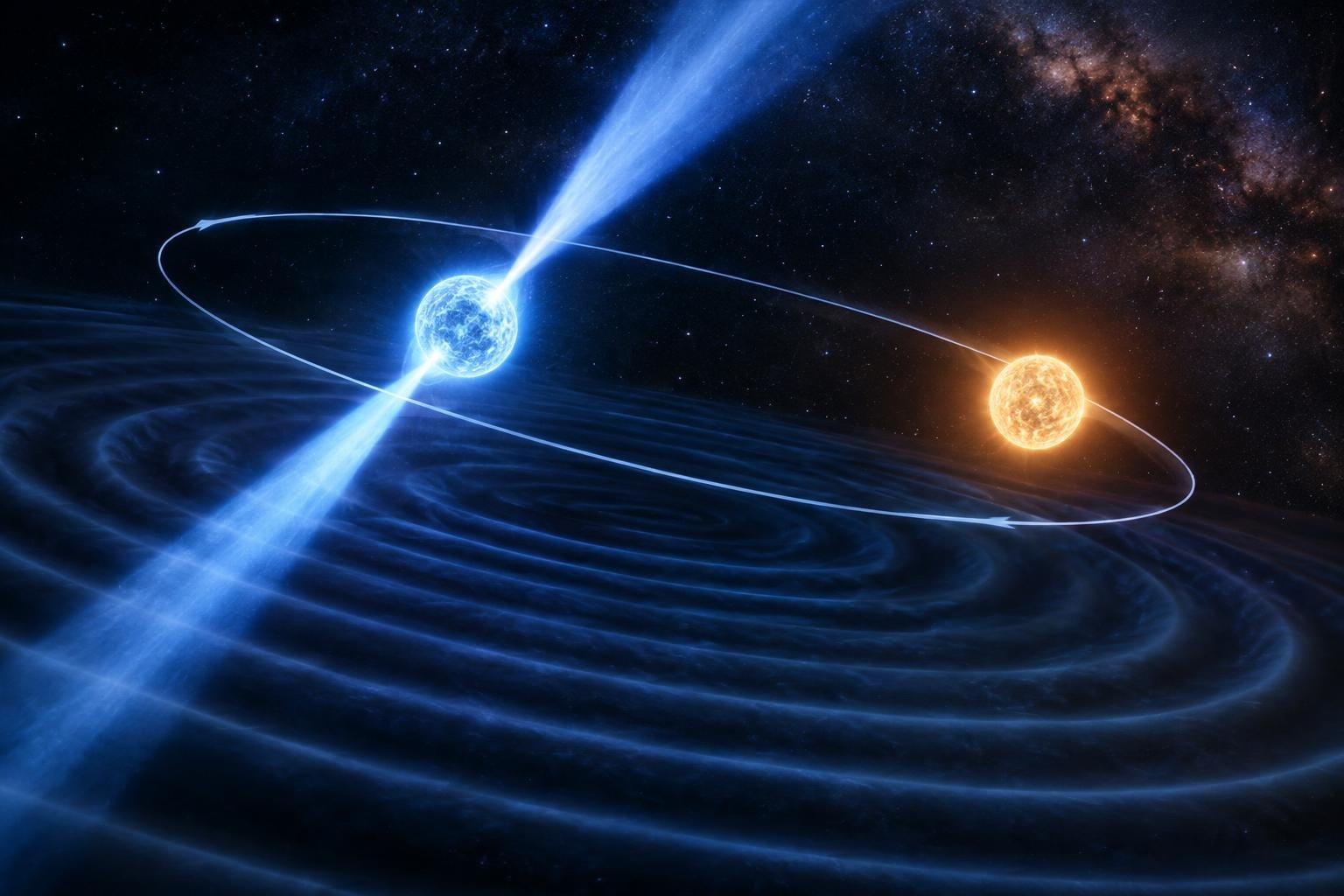
Imagine trying to keep time while hurtling around a star so dense that a teaspoon of its material would weigh billions of tons. In a newly studied system, one such star does exactly that: it flashes radio pulses toward Earth as it circles another neutron star every 2 hours and 22 minutes.
Those flashes are more than a signal from deep space. They are a remarkably steady clock, and their tiny changes in arrival time let astronomers track how the pair moves. The result is a demanding test of Albert Einstein’s general theory of relativity—and, so far, the theory passes.
Two stellar remnants, one extraordinary clock
Neutron stars are the crushed cores left behind when massive stars explode. Each packs more mass than the Sun into a sphere roughly 20 kilometers across. If one spins rapidly and its radio beams sweep across Earth, astronomers see a pulse each time the beam passes, much like flashes from a lighthouse.
The newly studied system, PSR J1856–0039, was first found in 2020 by China’s Five-hundred-meter Aperture Spherical Radio Telescope, or FAST. It lies an estimated 4,200 to 6,500 light-years away. FAST observations revealed that the pulsar spins about 43 times a second, while its companion makes it part of the lightest known pair of neutron stars.
The stars are separated by roughly twice the distance between Earth and the Moon. That may sound spacious, but for two objects each more massive than the Sun, it is a remarkably tight orbit. The system’s 2.36-hour orbital period is the second shortest known for a double neutron star system.
Relativity leaves three fingerprints
Between 2020 and 2025, researchers used FAST to observe the system 17 times, sometimes following it for a full orbit. They carefully measured when the radio pulses arrived, then compared those timings with models of how the stars should move. Relativity predicts several subtle changes that Newton’s simpler picture of gravity cannot fully explain.
One clue is that the stars are drawing closer, losing orbital energy as they send gravitational waves rippling through space-time. Their separation is shrinking by about 2.7 meters a year. Another is that the orbit’s oval shape slowly rotates, turning by 17.6 degrees annually. A third comes from time itself: as the pulsar moves through the changing gravitational field and changes speed, its clock ticks at a slightly different rate. The resulting pulse shifts reach about half a millisecond.
Here is what makes the measurement especially useful: any two of these effects can be used to calculate the stars’ masses. The third then acts as an independent check. If the theory describes the system correctly, all three should point to the same masses—and they do, to within about 1%.
A new test, not a final verdict
The pulsar weighs about 1.3 times as much as the Sun; its companion is about 1.19 solar masses. Together, they have the lowest total mass yet measured for a double neutron star system. That makes the pair more than a record-holder: it adds another extreme environment in which scientists can ask whether Einstein’s account of gravity still works.
It is not the most precise such test. The famous double pulsar has agreed with relativity to a much tighter margin, but that result drew on 16 years of observations. The new system’s agreement, based on about five years of data, is already impressive. For physicists hoping to find a mismatch that could point toward new ideas about gravity, the answer is frustratingly consistent: no crack has appeared yet.
The two stars are expected to merge in about 82 million years. Their collision may leave a neutron star roughly 2.26 times the Sun’s mass, though it could instead collapse into a black hole. Long before then, continued observations may reveal another subtle effect: frame dragging, in which a spinning object twists the space-time around it.
Detecting that twist could help researchers estimate how mass is arranged inside a neutron star, where matter is squeezed to densities impossible to reproduce on Earth. For now, PSR J1856–0039 offers a simpler but striking lesson: even a clock trapped in one of the universe’s most violent settings can keep time well enough to test the rules of the cosmos.